Filipinos around the world are mourning the death Crispin ‘Ka Bel’”
Beltran. A veteran organizer and people’s leader, Beltran died on
May 20 of head injuries sustained after falling from the roof of his
home in Bulacan. He was 75.
A long time trade union leader, Beltran was chairman of the Kilusang
Mayo Uno (“May First Movement”) until he was elected to the
Philippine Congress as a representative of Anakpawis Party-list. He
was a prominent leader in the opposition movement against the corrupt and
brutal rule of current president Gloria Macapagal Arroyo.
Beltran was a political prisoner during the Martial Law era of
fascist dictator Ferdinand Marcos. He was again detained by the
Arroyo regime under false criminal charges of rebellion and held
prisoner for more than a year in a hospital prison.
““I am innocent of the rebellion charge against me”,” he said upon
his release. “”It’s neither a sin nor against the law to speak against
graft and corruption and the killing of hundreds of innocent civilians.”
Unions, progressive parties, and peoples organizations are paying
tribute to Crispin Beltran and his more than 50-year commitment as an
activist.
“While Ka Bel didn’t get his wish that he die in the streets fighting
against tyranny and exploitation, he did not die in vain,” said Elmer
Labog of Kilusang Mayo Uno. “His whole life offered in the service of
the Filipino people and other struggling people in the world makes
him a hero no less.”
The National Union of Journalists of the Philippines (NUJP) hailed his
contributions to journalistic freedom. “Mr. Beltran was a tireless
leader, advocate and ally of workers, including those in mass media.
He was a fighter for press freedom and the right to free expression”
the NUJP said in a statement.
Bayan Muna, a progressive party-list, called his death “an irreparable
loss not only to the working-class movement but to every Filipino
yearning for genuine social change. He was a tower of a man, a pillar
of strength for the progressive people’s movement.”
Up until the end, Beltran remained a man of the people. In a
Congress dominated by millionaires, Beltran died still the poorest
member of the House of Representatives, with a net worth of only
50,000 pesos (CAN $1,149).
Basics Editorial
Basics Issue #9 (May 2008)
TCHC website shows this artist’s rendition of Phase 1 of “Revitalization” in Regent Park at Dundas and Parliament.
The future of Toronto’s social housing – how much there will be, where it will be located – will depend on the struggle of the people in Toronto’s social housing communities to demand and fight for better housing.
Residents of Lawrence Heights should brace themselves for the propaganda campaign that TCHC is set to unleash on them throughout the summer of 2008. Starting in May 2008, TCHC will choose its “Consultant Teams” which will begin deploying “community engagement” schemes in the community to get people on board with revitalization. Essentially, people can expect more of the same empty consultations with their “voices” falling on deaf ears.
On February 16, 2008 Basics Community Newsletter and a number of volunteer lawyers organized a legal clinic for residents at the Lawrence Heights Community Centre to fill-out Tenant Rights (T2) and Maintenance (T6) forms to the Ontario Landlord Tenant Board. Many families filled out these forms, with many more calling on Basics to help them with the forms in the weeks and months ahead.
However, TCHC and the Landlord Tenant Board have found sneaky ways to disqualify people’s applications.
In one case, a resident who filled out a claim to the Board was contacted by a TCHC representative asking the claimant to adjourn for another day. As nice as the tenant was, she agreed. Trustfully assuming that TCHC’s legal counsel would take care of the adjournment, the tenant in question did not show up for her trial. The tenant was sent a letter by the Landlord Tenant Board indicating that her case had been thrown out because she failed to show up. TCHC had successfully fooled the tenant from going to her own hearing.
Another claimant – who was also contacted by TCHC requesting adjournment – decided to ignore TCHC and proceed to the Landlord Tenant Board. Even though TCHC said that they could not attend, their legal counsel was in attendance. The results? The TCHC counsel told the adjudicator at the Board that they were not able to proceed with the case and that they had to reconvene another day. The Board went ahead and scheduled another hearing that was convenient for TCHC and not for the tenant. The tenant not only lost a day’s work, but she was sent home with a rescheduled hearing that she couldn’t even attend. In her words: “The system has failed me and this shows that the system doesn’t work for the working poor.”
There is a saying that goes: “Fool me once, shame on you. Fool me twice, I’m the fool”. TCHC tenants must learn from the experiences of their neighbours and not be fooled by the duplicitous slumlord.
These cases demonstrate that the law works to the advantage of the powerful. So people need to build their own community power to take control of their communities. So long as communities wield hundreds of thousands of dollars a month in rent money, people need to recognize that they already have community has power; but that power can only be used if organized.
One option left for residents is to flood the Board with cases. It will be very difficult for them to throw out tens or even hundreds of cases, and if they do they’ll only prove to us even more how useless their laws are for the community. The other option, whether or not people use the Landlord or Tenant Board, is to organize themselves into united community organizations to take further actions
The time to organize ourselves is here! Fight back through the Landlord Tenant Board! And if that doesn’t work, let’s unite as a community to fight for better housing! Only the people united have the power to make “revitalization” benefit the people. Contact Basics for more information! ?
by J.D. Benjamin
Basics Issue #9 (May 2008)
Three Philippine Congresspeople – Satur Ocampo, Crispin Beltran, and Luz Illagan – conducted a cross-Canada tour in April, meeting with local communities, academics, journalists, and politicians to help raise awareness of the rampant human rights abuses in the Philippines.
Since current President Gloria Macapagal Arroyo took power in 2001, over 900 activists have been killed and 180 forcibly disappeared. Ocampo and Beltran were victims of abuses through repeated criminal prosecutions based on fabricated evidence and false testimony provided by government agents. These and other abuses have been condemned by UN Special Rapporteur on extrajudicial killings Philip Alston, man countries and numerous international human rights organizations.
The tour featured public events and press conferences in Toronto, Montreal, Ottawa, Winnipeg, and Vancouver, a presentation to the House of Commons Standing Committee on Foreign Affairs and International Development, and a meeting with Manitoba premier Gary Doer.The legislators called on the Canadian government to review the foreign aid going to the Philippines to find out if any funds had been used by the Arroyo regime in its campaign of violence. Read more…
by Kabir Joshi-Vijayan
Basics Issue #9 (May 2008)
Since 2004, poor people in this city have had to deal with 6 major police attacks on their communities in Malvern, Galloway, Jamestown, Ardwick, Driftwood and most recently, the downtown East End. These raids involved hundreds of heavily armed cops and RCMP, undercover agents and paid snitches. They have arrested and jailed hundreds of youth, broken households and did absolutely nothing to address the conditions that force and lead people into crime in the first place. They seem directed more at terrorizing the people, and allowing the government, developers and landlords to further rob, destroy and vilify poor, black and racialized communities.
The most recent exposure of these raids was the 2005 police raid on Ardwick Boulevard, a small block off Finch and near Islington. Called “Project Flicker”, the sweep included over 300 cops who stormed the area as residents were still sleeping, arresting around 50 youth. The police claimed that all 50 were members of the Ardwick Blood Crew. Three years later, we find out that well over half of those arrested have been released, 20 were found completely innocent and the rest have had many of their charges dropped. In other words, this was definitely not the huge ‘threat’ the police and media had talked about back in 2005. A lawyer for one of the accused believes the mass arrests were aimed more at showing Toronto was ‘safe’ and open for business during a year when many people were shot in the city.
However the fact that so many innocent people are arrested assaulted and jailed by the cops during these attacks on our neighborhoods is no surprise to anyone who’s experienced a raid. When Driftwood (in Jane and Finch) was raided last summer, Police busted up houses and destroyed furniture, threatened kids and mothers with machine guns, and brutalized and handcuffed a number of people (including a grandmother) for simply being in the wrong house! Many of the people arrested didn’t commit any crime themselves, but were charged with ‘belonging to a criminal organization’, or with simply being in or renting a house where drugs and weapons were supposedly kept.
Besides exposing the violent and brutal tactics used by police, raids are also an example of how landlords and cops work together to oppress our communities. For example, after the 2005 raids on Jamestown (in Rexdale), which arrested around 100 people, TCHC (Toronto Community Housing) evicted the families of many of the youth arrested – before the youth were even put on trial! Many tenants have already been kicked out, while others have (and continue) to fight the notices. Despite the main and obvious point that a whole family has nothing to do with what one member does, the outcomes from other police raids show us that many of the people arrested were innocent to begin with.
The latest major raid TO cops have conducted happened this past February/March 2008. During a six week period, which included a major undercover operation and multiple raids, Police of 51 Division arrested almost 300 people in the Church and Seaton area (just east of Regent Park). According to police, the raid was focused on “drug dealers, prostitutes and aggressive panhandling (begging)”!
In other words, we are supposed to congratulate the cops for throwing in jail the poorest people in one of the poorest areas of Toronto. This comes of course as the city is tearing down Regent Park, and cutting off services to the poor (including shutting down 3 rooming houses and shelters in the targeted area), forcing people further into a situation where they have to beg, sell drugs, or sell themselves to survive or get an income. This raid is clearly just one part of the city’s/TCHC’s plan to take all community housing and poor people out of the Downtown East end (including Regent Park) in order to make way for land developers and condos. The raid was even code-named “Project Revival”, the similar term used to disguise the breaking down (“revitalization”) of Regent and the surrounding area.
So as we head into summer and people in hoods throughout the city are noticing a beefing up of police presence, along with the continued tearing up of our communities, we must be ready to defend our homes against future attacks – whether by the police or their partner landlords. ?
Basics Editorial
Basics Issue #9 (May 2008)
Quite often cultural and religious identities like “Black”, “Arab”, “Christian”, or “Muslim” are used by organizations to rally an identity group in such a way that hides serious class differences and political differences within those organizations. Often, though not always, the leaders of such organizations are individuals who maintain cozy relationships with government or big business. The Justice for Alwy (J4A) campaign recently learned this lesson the hard way when it was blocked from speaking at a conference organized by the Arab Community Centre of Toronto (ACCT).
Upon learning of the J4A Campaign against police brutality, an individual from the ACCT requested that the J4A Campaign have speakers at one of its upcoming conferences. The May 3rd conference was entitled “Arab and Muslim Identities on Trial: Youth Step Up and Speak Out”. Only days before the conference, members of the J4A campaign were contacted and told that they would no longer be allowed to speak at the conference because of “liability issues”. It seems like Arab and Muslim youth are allowed to step up and speak out only on those issues that really don’t matter in the community.
Upon further investigation, members of the campaign learned that the ACCT is funded by Citizenship and Immigration Canada and also receives money from the City of Toronto. Furthermore, the RCMP were among the panellists at the conference.
Following in the footsteps of Toronto Parks and Rec. Manager Lucky Booth of the Regent Park Community Centre South, once again a Toronto Community Centre has closed its doors on the struggle of youth and mothers in the community trying to expose and resist police brutality.
In an Open Letter to the ACCT, the J4A campaign wrote, “We are more and more coming to understand that entities funded by the government cannot be relied upon to be apolitical organizations, and thus can not fully serve the people and the communities under whose name they work..”
The Arab Community Centre of Toronto cannot claim to represent the interests of Arabs if when one of their community members is senselessly murdered by the state the result is that organization takes the side of the state.
The people should not expect government-funded “community”centres to work for them unless the community itself has control over those centres. ?
by Alok Premjee
Basics #9 (May 2008)
Three New York police officers who shot and killed Sean Bell in a hail of 50 bullets in
November 2006 have been acquitted of all charges by the New York State Supreme Court. Before announcing his verdict on April 25, 2008, the judge stated that he found the police had a more credible story than that of the victims.
No weapon was ever located at the scene, yet that was supposedly the motive that triggered the police to blast away.
This should come as no shock to people in Toronto, where more than six months after the murder by police of 18-year-old Alwy Al-Nadhir there is still no response from the S.I.U. investigation. The family and friends of Alwy are bracing themselves for an equally unjust verdict, given the outrageous acquittal of Toronto police officers in the May 2004 killing of Filipino youth Jeffrey Reodica.
The recent murder of the indigenous man Byron Debassige in February 2008 for stealing two lemons in the Yonge and Davisville area demonstrates that Toronto police are not all that different from New York police. ?
by Alok Premjee
Basics Issue #9 (May 2008)
If the amount of homeless people in Canada isn’t enough of an indicator of the injustice in this country, then look to the murder of the homeless man Paul Croutch in 2005 for more proof. On August 31, 2005, three Canadian soldiers beat to death 59-year-old homeless man, Paul Croutch.
Jeffrey Hall, 24, Mountaz Ibrahim, 25, and Brian Deganis, 23, were all charged with second-degree murder in the death of Croutch. Two of them were convicted with manslaughter charges after plea-bargaining and will serve sentences of five and ten years each. The third soldier, Ibrahim, will serve a mere 10 months for his role as an accessory.
A witness who was assaulted as she intervened in the fatal attack told the courtroom that one of the soldiers “shoved his dog tags in my face. He said this gave them the right to kill all derelicts, crackheads, whores and bums. And that I needed to tell all my friends – this was their park.”
If these are how Canadian soldiers feel and treat the marginalized and poor people in Canada, then we can only imagine the hatred they must have towards the peoples they have occupied in recent years in Afghanistan and Haiti. The bigger question is whether these are the attitudes that Canadian soldiers are taught as they are trained to become professional killers. ?
Rest in Peace, Mr. Croutch
by Sara Falconer
Basics Issue #9 (May 2008)
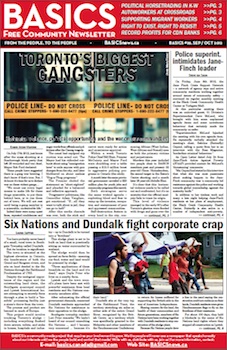
A recent standoff between First Nations people and the cops has ended in six new arrests, bringing the total number of First Nations people facing charges from land struggles into the double digits. Are they Ontario’s political prisoners?
The storm around First Nations land claims has been brewing over the past several years around several controversial uranium mining and development projects. On April 25, Ontario Provincial Police (OPP) drew guns in a confrontation on Tyendinaga Mohawk Territory near Deseronto. Solidarity blockades and actions took place at Six Nations, Akwesasne, Kahnawake, Guelph, Ottawa, Toronto and Vancouver over the following four days. After the OPP withdrew from Tyendinaga on April 29, the other blockades were dismantled.
Mohawk warriors have occupied a quarry on the disputed Culbertson Tract for over a year. The latest conflict began when spokesperson Shawn Brant was arrested on an outstanding weapons charge, less than two weeks after he was acquitted of uttering threats at soldiers at a 2006 demonstration. Read more…
Basics Editorial
Basics Issue #9 (May 2008)
Late in the night of April 22nd, 2008, a team of heavily armed and masked officers from the Emergency Task Force (ETF) and the Guns and Gangs Task Force broke into a Somali family’s home late at night in the East Mall area of Etobicoke.
The cops were supposedly looking for a firearm on an anonymous tip, but no guns or any other contraband were found. No charges were laid, other than a fail to comply with a curfew.
The cops ransacked the house, terrorizing the mother and viciously beating both her sons, leaving the 23-year-old son so severely beaten that he was hospitalized and has sustained permanent brain damage. The Special Investigations Unit (SIU) is now investigating. However, when ex-cops investigate cops, we know what happens: nothing. The only option is for the community to organize in response to police brutality. We must organize ourselves to break the siege on our communities! ?
Basics Editorial
Basics Issue #9 (May 2008)
This issue’s enemy of the people is a familiar name to working people in Toronto.
Julian Fantino, notorious former Chief of Toronto Police who let the Police terrorize communities for 5 years from 2000-2005, has been spreading the fear across Ontario since Dalton McGuinty appointed him as Chief of the Ontario Provincial Police (O.P.P.)
More recently, Fantino has been attacking indigenous communities that are rightfully protecting their lands against a federal and provincial governments that have been allowing developers, mining companies and other big-business thieves to illegally exploit unceded Native territories . Fantino’s O.P.P. have arrested a number of indigenous leaders, including Bob Lovelace and Shawn Brant in an attempt to try to stomp out resistance from First Nations communities.
Fantino should know from his time in Toronto that his attempts to stomp on the rights of oppressed people will only serve to show people what the nature of the police really is – to protect the wealth of the ruling class (even when the ruling class steal that wealth). Julian, you will always be an enemy of the people. ?