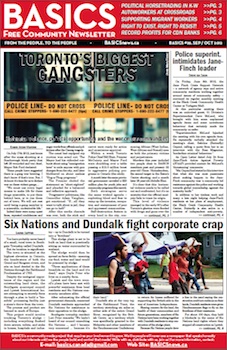
The Red and Black Star Shines Brightly in the Night as CUPE 3903 Goes On Strike
by Dhruv Jain Basics #11 (November 2008)
At 10.39 pm on November 5th 2008 a cheer erupted in Curtis Hall I at York University as the Canadian Union of Public Employees (CUPE) Local 3903 in consultation with its members decided to go on strike. The membership voted, in a demonstration of union democracy at a ‘Special Consultative General Membership Meeting’, 71.7% to recommend to the Union’s Bargaining Team and Executive that they reject the ‘final offer’ of the Employer. The Executive and the Bargaining Team accepted the recommendation of the membership unanimously.
CUPE 3903 represents approximately 3,350 members who work as Teaching Assistants (TA’s), Contract Faculty, Graduate Assistants (GA’s) and Research Assistants (RA’s). The Union last went on strike in 2000-2001 when York University attempted to make the Union concede the tuition rebates it had won in previous rounds of bargaining. The long strike was finally won by the Union after 76 days, the longest strike in the education sector. Picket lines will go up at both the Keele and Glendon Campuses at 7 am and come down at 7 pm starting 12.01 am November 6th, 2008.
The Union is striking this time over poverty wages for its workers; better job security for contract faculty; increases to funds that reflect the increases in membership in the last several years; and a 2-year contract. York University for its part has been unwilling to move on any of the demands seriously and has offered wage increases over 3 years that fall far below the projected inflation rates in the next 2 years. Furthermore, the University has refused to give better job security despite the fact that the York University Faculty Association (YUFA) and CUPE 3903 have agreed upon an outline for a proposal. The University’s counter-proposals regarding funds available to members were considered insulting by nearly all in the room, including a paltry $1500 dollar increase for childcare. And the cherry on the top of this cake is the University’s refusal to accept a 2-year contract that would allow CUPE 3903 to bargain in 2010 as has been mandated by the Ontario University Workers Coordinating Committee, a sub-committee of CUPE Ontario, so that all education sector locals will be able to engage in ‘coordinated bargaining’. The University has similarly brushed other demands such as serious movement on tuition rates, health benefits, and smaller class sizes. The University claims that the demands of the Union are “unreasonable” despite the fact that the same University has been willing to give 15.6% wage increases to their own corporate bigwigs.
The ball is now in York University’s court to actually make a deal that the Union could seriously consider. As tired and sleepy CUPE 3903 members boarded the 196 Rocket from York University to Downsview Station, past midnight, they sang loudly, clearly, energetically and enthusiastically, “We’ll go all the way!” And they sang it once more on the long subway ride home.
by Erica Peña & Nico Lopez (of Barrio Nuevo) Basics #11 (November 2008)
As a launching initiative for Frente Norman Bethune [FNB], this past October several community organizers and hip hop artists visited Canada from Venezuela for an 18-day tour. The Venezuelan delegation included members of Comite Nacional de los Sin Techos (National Homeless Committee), and rap-groups Familia Negra, and Area 23. They came to our corner of the world to learn a little more of what hip-hop group Familia Negra poetically refers to as Babylon. During very intense and important times they had the opportunity to compare the social, economic and political situation in their homeland with what they experienced in Toronto, Ottawa, Montreal and Haudenesaunee (Six Nations Confederacy). Surprised and curious about the rich cultural diversity in our neck of the woods, the delegates of FNB shared their revolutionary messages not through hip hop music, but also during discussions and meetings with local organizations.
Besides opening dialogue with diverse groups of people to inform them on the positive changes in Venezuela, which our mass media rarely mentions (if at all), visiting FNB delegates met with grassroots collectives and student organizations, inviting them to participate in this Toronto-based exchange project that can bring us closer to their people’s movement. The exchange will initially allow people from Canada, Quebec , and indigenous territories to travel to Venezuela to volunteer in specific tasks during 3 or 4 weeks, during which they will be exposed to a vibrant social and cultural urban (or semi-rural) landscape. Set out to take organizers and activists to a country that has been in the spotlight of international news during the past decade, FNB is not just a solidarity effort to build stronger North-South ties: it is also an amazing learning opportunity for those actively involved in progressive social change, and especially for those who intending to increase their community organizing involvement in the future. Read more…
by Elijah Whitaker
Basics #11 (November 2008)
On September 13, 2008 the Justice for Alwy Campaign held its first ever Annual 3-on-3-Basketball Tournament. ‘The 1st Annual Justice for Alwy 3-on-3-Basketball Tournament’ was borne out of community concerns over police brutality – namely after Alwy al-Nadhir, an unarmed Toronto youth, was shot and killed by Toronto Police last Halloween. Out of this tragedy, Alwy’s family, friends, and other local community organizers saw the need to get organized to put an end to the siege on our communities. Together, they created the Justice for Alwy Campaign Against Police Brutality.
The Tournament was held at Carlton Park, located in the south west side of the city near Symington and Dupont. Teams registered from all over the city, including teams from Pelham Park, Jane and Finch, Markham, Scarborough, Regent Park and many more areas throughout the city. With players, spectators, volunteers and organizers, the event drew over 100 people. And despite the pouring rain and a slippery court, the tournament saw high-level competition and intense games, accompanied with music and a BBQ to top it off.
As for the tournament itself, teams from Pelham Park dominated both the adult and youth divisions. In the youth division, Pelham Park Young Set went undefeated throughout the entire tournament. With stellar performances from Gordel, Rushown, Daniel, J.R, and Marvin, they were able to tear through the competition eventually beating neighbourhood counterparts Clinton, Pedro, and Squid of Triple Threat in the finals.
In the adult division, another team representing Pelham Park went undefeated. 5-Point, which consisted of Richard Campbell, East Ka$h, P Nise and Bravo proved to be too much for the adult division, beating another local team Trend-Setters (Chevy X, Marbles, Prince, Kevin Campbell, Kris Neptune ) in the finals.
Congratulations to both teams!
Basketball aside, the political purposes of the event itself – uniting to express our opposition to police brutality – was not lost. Being at the event, it was clear from the discussions many of the youth were having that there are serious tensions between many youth and Toronto police. The frustration was palpable – many expressed discontent over the overall policy of community policing, many exchanged experiences about the daily harassment, false arrests, brutal beatings and verbal confrontations many have with the police.
Community concerns over police brutality and racial profiling are, of course, not new to the city. The Black Action Defence Committee has been organizing around the issue of police brutality for a number of years, and with the recent police killings of Freddy Villanueva, Alwy al-Nadhir, Byron Debassiege and the 2004 murder of Jeoffrey Reodica, the already frayed relationship between youth and the police might be worsening.
In the end, organizers thought the event was a great success and are excited about next year’s tourney.
by Mike Brito Basics #11 (November 2008)
On September 29, Shawn Brant, a spokesperson of the Mohawk Nation, was convicted of a mischief charge for taking part in a series of highway and rail blockades in 2007. The crown had been asking for 12 years jail time but had to back off after details about the OPP’s corrupt handling of the situation became public. This included evidence that the OPP did not follow their own guidelines, set up illegal wiretaps, mobilized snipers and armored personnel carriers, and gathered evidence on protests while posing as journalists. OPP commissioner Julian Fantino would have been subpoenaed had the case continued and Brant gone to trial.
The Mohawks of Tyendinaga have been struggling to achieve justice, despite the consistently poor response on the part of the Canadian Government to unresolved land claims from all over the country. Many of the people in Tyendinaga have not had access to clean drinking water for at least 10 years. In Tyendinaga their struggle has taken the form of economic disruption, which has included road and rail closures and the disruption of businesses profiting from the unresolved lands. The current campaign began in November 2006, when Mohawks announced that they would stop the construction of a subdivision on the Culbertson Tract, which is part of Tyendinaga’s land claims. There was a blockade of a military convoy on the reserve that month. In March 2007, a quarry that had been operating on the Culbertson Tract was shut down permanently. On April 20th the C.N. main rail line running through the territory was closed for 30 hours. Again, during the National Aboriginal Day of Action on June 29th, 2007 the C.N. main line, Highway 2, and the 401 were targeted and closed for 24 hours.
On June 26th, 2008 Brant was released after more than two months in jail. Brant was being held on false charges alleging he had assaulted a white local businessman during road blockades that began on April 20th 2008. Brant challenged two local racists from neighboring Deseronto, ON, after they attacked a small group of mainly Mohawk women and children. The blockade had been erected the day before, targeting a land development on stolen Mohawk land. One man flew into a rage when he was turned back at the roadblock, swinging a bat at protesters, and even hitting a woman with his car. Although residents of Tyendinaga called 911, the police never laid any charges against the violent racists. Brant arrived at the scene and demanded that the attackers leave, and was consequently arrested several days later. At the time, Brant was living under strict conditions imposed as part of his bail from the June 2007 Aboriginal Day of Action, and was not even taking part in the blockade. Brant was arrested and held in pre-trial custody.
Shawn Brant is now facing one year probation and was ordered to stay on the Tyendinaga reserve for three months as a result of the recent convictions. There are at least 16 other members of the Mohawk Nation still facing charges from their participation of actions in defense of their communities.
by Kabir Joshi-Vijayan Basics #11 (November 2008)
We can all breathe a sigh of relief. Canada just convicted its first “terrorist” in September, and there will likely be more to come. The twenty-year-old man (who was seventeen at the time of his arrest and cannot be named) never endangered anyone’s life, never damaged any property, never made or used explosives, never used a weapon, did not produce any terrorist plans and did not even know about any specific terror plot. However, he did get caught red-handed shoplifting. He was also a Muslim convert.
So how was the youth convicted on charges of terrorism? It was done by altering the whole criminal justice system through new legislation (Canada’s Anti-Terrorism Act), which was zealously passed after 9/11 and renewed shortly after the dramatic arrest of the convicted youth and 17 other Muslim boys and men in June of 2006 (the widely sensationalized and discussed ‘Toronto 18’). The Act created an entirely new category of criminal (“the terrorist”) whose crimes are motivated for religious or political reasons, and so requires investigation into the intention of the suspect, who he associates with and what he believes in. Such a directive is inherently prejudicial in application and promotes racist profiling. In addition, the new law also broadly defines what a “terrorist group” is, so less evidence is needed of any offence by the group and proof as flimsy as planning or even discussion of certain actions becomes the basis for conviction. This is particularly troubling because of the role played by two paid government informants in the ‘Toronto 18’ group, including the purchasing and storing of the alleged bomb making material, and possibly entrapping and encouraging the 18 arrested. These two rats were collectively paid over 4 million dollars for their “public service”!
Prosecutors were able to get a successful conviction simply because the judge believed a terrorist conspiracy existed and the youth happened to attend two camps with the alleged “conspirators”. It is sort of like guilt by association, except that the “conspirators” themselves have not been convicted of any crime.
The conviction of the youth is just another example of Canada legislating and legalizing state terror against Arab and Muslim communities, whether it’s security certificates that allow for indefinite detention of non-citizens, facilitated torture of citizens in foreign prisons, hyper surveillance of Muslim and Arab communities, hundreds of illegal detentions of Muslims and Arabs on a daily basis, or Canada’s murderous contributions in war in Afghanistan. This terror conviction, and the mass arrest of the ‘Toronto 18’ over two years ago, have and will continue to serve as justification for these various attacks on Muslim people, at home and abroad.
Ten of the eighteen arrested in 2006 remain in jail awaiting trial, and three of those men continue to be brutally held in solitary confinement since that time! The lawyers of the convicted youth plan to appeal the terror ruling in December. Regardless of the outcome, the current conviction has served to amplify fear in Muslim, Arab and other vulnerable communities – who fear the real terror that will be unleashed by Canadian security agencies invigorated by their first successful terrorist conviction.
by Hassan Reyes
Basics #11 (November 2008)
On October 18th, Toronto’s VIDA Lounge was graced by some of the best revolutionary hip-hop in any language.
The Movimiento show featured 2 of Venezuela’s premier hip –hop acts: AREA 23 from the infamous 23 de Enero neighbourhood and artists/ community activists Familia Negra blessed the stage for their first visit in Canada and Quebec. The Venezuelans were accompanied by Toronto latin hip-hop pioneers Code Blue who are about to release a new album, ‘Premature’.
The concert was part of the 1st round of FRENTE NORMAN BETHUNE, a movement started by Barrio Nuevo to build people-to-people solidarity with Venezuela, as well as to coordinate on-the-ground community-organizing training for organizers in Canada, Quebec and First Nations territories to train in Venezuela.
Other acts who also lent their talents for the night included Vaughan and Oakwood’s Wasun, spoken word artist’s Sun and Spin as well as DJ D Boyz from Cuba and eLman from Dos Mundos Radio on the turntables.
Movimiento capped off a successful first tour that included similar performances all over Toronto as well as Montreal and Ottawa.
The crowd was treated to some of the best conscious hip-hop culture that this hemisphere has to offer, as well as being shown that the people of this hemisphere are coming together to fight for our common struggle.
by Lucho Granados Ceja (of Barrio Nuevo) Basics #11 (November 2008)
On September 21st, 2008 community activists from Barrio Nuevo teamed up with several Latin American artists to paint a mural on a wall at 40 Driftwood Avenue, in the Jane-Finch community. The mural was painted in honour of the Incan prophecy of the 10th Pachacuti. The prophecy speaks of the reunification of the Eagle (the peoples of North America) and the Condor (the peoples of South America) in order to bring peace and balance to the world.
Cecilia Alejo, one the artists, said “Arts-based initiatives such as this one offer an opportunity for self expression, while at the same time providing a reflection of the community and an expression of unity.” The mural, a mixed media piece with graffiti art elements, even attracted the attention of local youth who spontaneously lent a hand. These youth not only took ownership of the mural but their street as well and provided a culturally-relevant community landmark.
Where the reality is that our neighbourhoods face decades of neglect, these sorts of initiatives allow artists to beautify them and at the same time display an element of our history on the street for the community to appreciate. Barrio Nuevo plans on securing more space for this sort of activity in more neighbourhoods in the future.
To get involved is future initiatives like this, people are encouraged to contact us at [email protected].
by Justin Panos
Basics #11 (November 2008)
October 28 of this year marks Omar Khadr’s sixth year as a detainee of America’s concentration camp at Guantanamo Bay, Cuba. The detention centre is declared by the United States to be sovereign US territory (even though it is part of mainland Cuba).
Khadr, a Canadian citizen born in Toronto, was captured in a skirmish between Afghan civilians and US soldiers in an Afghan village in July 2002. It is claimed that Khadr threw a grenade that killed a US soldier. Khadr was found huddled in terror by the armed soldiers and was promptly shot twice in the back. Omar, now 21, is the youngest detainee at the highly securitized and secretive prison establishment. He has been there since he was 15 years old and has neither been charged with a crime nor faced a judge or jury of his peers. Read more…
by N. Zahra
Basics #11 (November 2008)
On September, 30th, 2008 the Ombudsman of Ontario, André Marin, released a special report that slammed the Special Investigations Unit (SIU) for its “culture of complacency” and a lack of rigour in ensuring police follow the rules. The SIU, a so-called “civilian agency”, was formed in 1990 by the Ontario provincial government after the long struggle of community-based mass campaigns against the long history of police shootings and murders throughout the 1970s and 1980s.
Since the SIU’s inception, there have been several reports calling for its reform because so far it has been ineffective in carrying out its mandate of police accountability. In his detailed report, Marin summarizes these reports and claims that although more resources were thrown into the SIU and its regulatory requirements were more clearly defined, the SIU still fails to carry out its mandate because of the influence of “powerful police interests.’”
Marin, the Director of the SIU from September 1996 to June 1998, has more than a passing familiarity with the difficulties the SIU has in fulfilling its mandate. Marin identifies “aggressive resistance from the police community” as one of the primary factors inhibiting change. He notes that amongst families of victims, lawyers and community members, the SIU lacks any credibility because of its shameless links with the police community. He points to the continuing police links of former police officials within the SIU as well as the fact that the SIU is steeped in police culture to the point that it tolerates the blatant display of police insignia and affiliation.
Another major problem Marin identifies is the SIU’s complacency when dealing with police officials’ failure to comply with SIU investigations. The SIU treats police witnesses different than civilians. Delays in police providing notice of incidents, disclosing their investigation notes and submitting interviews are all endemic. The SIU does not keep a record of incidences of police failure to comply and Marin says that the SIU takes a “conciliatory” approach when dealing with what they treat as isolated incidents of police failures to comply. Interviews with police are rarely held within the regulatory time frame, sometimes taking place months after the incidents. The SIU will not interview police when they are off duty and it makes every attempt to cover up police non-cooperation so that it does not come into the public eye.
Perhaps even more alarming, Marin points out a fact that critics are all too aware of, which is that much of the SIU investigation remains hidden from the public eye. Director’s reports are not accessible to the public.
Despite Marin’s identification of the shortfalls of the previous recommendations made for SIU reform in previous reviews, his very own recommendations are quite vague and do not go any further than calling for legislative reform in regards to the agency. His recommendations include the following: the SIU using any means available to diversify its workforce; that the director’s reports are made completely public; and that the province should amend legislation to make it an offense for police forces not to co-operate with the SIU.
Although Marin’s report is an important document that summarizes the many problems with the SIU, it does not go far enough. In order for police to be held truly accountable for their murders of innocent civilians – such as Otto Vass, Jeffrey Reodica, Alwy Al-Nadhir, and Byron Debassige, in the last five years – mere legislative changes and reforms will not cut it. The people need to hold police accountable for their actions by mobilizing to create a truly civilian-run force that is independent of police interests and pro-cop government interferences. Let’s organize for justice now!
by Makaya
Basics #11 (November 2008)
Basics Community Newsletter has expanded its work by venturing into the world of radio broadcasting. Basics is pleased to be hosting our very own show on CHRY 105.5FM in the Jane and Finch area, every second Wednesday from 8-9pm. Live-to-air broadcasting is just another way we are getting our vital information to the masses. The show combines live interviews, music, current news issues, reports from recent events, as well as listings for upcoming events and much more.
For our debut show we interviewed Odion Osegyefo from the African Internationalist Students Organization and the African People’s Socialist Party; Chris Bolton, a Toronto District School Board Trustee who has come out against armed cops in Toronto schools; and investigative journalist Kevin Pina, who discussed the current situation in Haiti after Hurricane Ike in the context of ongoing political repression by the foreign occupation forces. Since then we have held many interviews, including a phone interview with Jennifene Debassige, the mother of the young Native man slain by Toronto Police, Byron Debassige. We also interviewed local musicians and community activists, such as the Soca Emperor and Wasun from Black Action Defense Committee.
On our October 15 show, we featured Venezuelan rap group Familia Negra, who were in our studio to discuss the Bolivarian Revolution in Venezuela, Hugo Chávez, and to perform some freestyle; and we also interviewed Will Prosper of Montréal-Nord Republik to discuss the popular resistance to police terror in the community. We have also been providing important updates on the current crisis in the global economy, and how capitalism’s richest billionaires are attacking people around the world and in Canada in order to keep themselves rich.
Radio Basics reflects many of the topics featured in our paper and issues unfolding in our communities. Radio Basics is from the people, and to the people, and this show is truly is revolutionizing radio! If you have not yet had the chance to hear the new audio component of the Basics Free Community Newsletter, tune in every other Wednesday from 8-9pm on 105.5 CHRY or online at www.chry.fm, or visit basicsnewsletter.blogspot.com to check out our audio library of past shows. Radio Basics will be airing its next shows on Nov. 12, Nov. 26, Dec. 10, and Dec. 24.