Barrio Nuevo is a Latino community organization in Toronto which runs the radio program by the same name on Voces Latinas 1610AM. Barrio Nuevo is also the founder of the Frente Norman Bethune international exchange of community organizers, information of which can be found elsewhere on our website.
Barrio Nuevo strongly condemns and opposes the military coup d’état carried out today in Honduras forcibly removing the democratically-elected President, Manuel Zelaya. We call for the immediate reinstatement of President Zelaya and for those responsible for ordering and carrying out the coup d’état to be brought to justice. Furthermore, we call for the Canadian government to condemn the coup and to not recognize any illegal government in Honduras. Barrio Nuevo stands in solidarity with the Honduran people as they mobilize in the streets to denounce the coup in the face of violent repression from the military. For a report on the crisis in Honduras, click here: http://english.aljazeera.net/news/americas/2009/06/2009628124715921328.html
Please call or send a message to Lawrence Cannon, Minister of Foreign Affairs, demanding that the Canadian government 1) denounce the coup d’état; 2) not recognize any illegal government in Honduras; 3) call for the immediate reinstatement of President Zelaya. Please send copies of any correspondence to Minister of State for the Americas, Peter Kent, and to the leaders of the three opposition parties. Finally, we call on our allies and progressive organizations in the GTA to support Honduran democracy, to call for President Zelaya’s reinstatement, and to remain vigilant as further actions and demonstrations are organized. To contact Barrio Nuevo, please send an email to [email protected].
Contacts:
Lawrence Cannon, Minister of Foreign Affairs
Tel: 613-992-5516
Fax: 613-992-6802
Email: [email protected]
Peter Kent, Minister of State of Foreign Affairs (Americas)
Tel: 613-992-0253
Fax: 613-992-0887
Email: [email protected]
Michael Ignatieff
Email: [email protected]
Gilles Duceppe
Email: [email protected]
Jack Layton
Email: [email protected]
We are a network of workers, advocates and community allies who are calling for fundamental changes to the federal Live-in Caregiver Program (LCP) and other Temporary Foreign Worker Programs (TFWP).
Canada is a country of immigrants. It continues to need immigrants to sustain growth in its economic and cultural life.
Over the last 30 years, the failure of our federal and provincial governments to adequately address the gaps in Canadian immigration and labour policy has led to the systemic discrimination and exploitation of migrant workers, including caregivers under the LCP and others under TFWP.
Our communities do not want the growth of Canada, as a nation, to be based on the systemic discrimination and exploitation of migrant workers!
We are calling for the following changes:
Organized by the Coalition for Change: Live-in Caregivers and Temporary Foreign Workers
Organizations that endorse this rally include: Adhika-Phillipne Development Concerns, Caregivers Action Centre, Caregivers’ Connection, Colour of Poverty Campaign, CAW- Canada, Community Alliance for Social Justice (CASJ), Filipino Centre-Toronto, Filipino Ministerial Fellowship, Gateway Centre for New Canadians, Good Jobs for All Coalition, Independent Workers Association, Justicia for Migrant Workers, Migrante-Ontario, No One is Illegal – Toronto, Parkdale Community Legal Services, Santiaginian Association of Ontario, Silayan Community Centre, United Food and Commercial Workers-Canada, United Steelworkers and Workers’ Action Centre.
–
Visit: migrante.ca
~*~*~*~*~*~*~*~*~*~*~*~*~*~*~*
Migrante-Ontario member organizations:
Filipino Migrant Workers Movement; AWARE; Philippine Advocacy Through Arts and Culture (PATAC); Damayan Migrant Education and Resource Center; Migrante Youth; Migrant Workers and Family Resource Center – Hamilton; Pilipinong Migrante sa Canada (PMSC) – Ottawa; Pilipinong Migrante sa Barrie (PMB) – Barrie
More police brutality not the solution to violence in our communities
by Kabir Joshi-Vijayan and E. Jamal Chang
BASICS #14 – June/July 2009
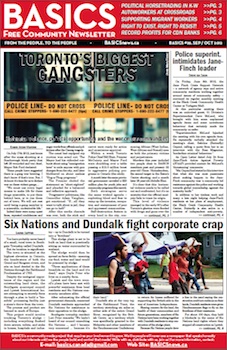
There has been a lot of talk recently about the supposed ‘gang war’ in some of Toronto’s poorest neighbourhoods. Over 12 people have been murdered and more than 50 shot in the west-end since January alone; including a 14 year-old youth gunned down on Scarlett Road, and a 5 year-old girl who survived a stray bullet to the chest at Lawrence and Weston. City politicians, corporate media reporters, and so-called “community organizations” have been discussing the conditions in and solutions for the largely black and brown areas experiencing the violence. But the commentaries and proposals have been flawed, and even racist, since they have ignored the role of the state in both causing and creating the conditions that cause violence in the first place. So the project now being enforced on the city’s poor and racialized communities as a solution to gun violence is the boosting and backing up of what could be described as this city’s largest gang: the Toronto Police.
Any honest discussion about the violence in low-income communities in Toronto and elsewhere must acknowledge that police brutality is routine and systematic. It is experienced daily; it is cold, calculated, raw, and at times, homicidal. Because of this, many residents of these communities approach the police with fear, and at times even frustration and anger.
The story of Shak featured in this issue is just one example of violence the Toronto Police are well known for, brutality that escapes both the media lens and any public accountability. Shak’s only “crime” was informing his neighbours that suspicious men (police) were lurking in their backyard. For this the cops pulled Shak off his bike, dragged him out of sight and violently beat him so badly that he later fell unconscious. He is in grade nine. Only one week after that brutal attack, the Toronto Sun released information about 2 black youth in Richmond Hill who were nearly beaten to death by eight masked York cops in September. The cops had broken into their hotel room and tazered them 24 times, leaving one of the youth unconscious and nearly blind in one eye.
Police Brutality in its most extreme form, murder, also takes place in this city regularly. Most notably, 17-year old Alwy Al-Nadhir who was murdered on Halloween night 2007 and Byron Debassige on February 16, 2008.
These acts of violence don’t only affect their direct victims, but are used to terrorize, contain, oppress and silence whole communities. Even families who have the courage to speak out are confronted with a state that uses every means – from the media, to the court system, to the corrupt SIU – to cover up for and justify police brutality.
In this way, the police are agents of the very activities they claim to act against: their fists bruise, their batons smash, and their guns kill. Amidst a worsening economy, poor housing conditions, gentrification, and an unhealthy relationship with police forces, how can we expect to see any real changes in our communities? When the school system isolates, and expels our youth, when the economy leaves them with no opportunities, and when our neighbourhoods are flooded with weapons and drugs, what is to be excepted other than a rise in crime?
The only solution is to come together and unite in our neighbourhoods, to mobilize so we can end the violence ourselves, whether caused in our communities, or from the hands of those employed “serve and protect”.
by S. da Silva – BASICS #14 (June / July 2009)
In early 2006, the Haudenoshaunee (“Iroquois”) people of the Grand River Territory began a reclamation struggle to halt the “Douglas Creek Estates” housing development on the outskirts of Caledonia, Ontario, which was being constructed on their unceded lands. Since then, people from Six Nations have continued organizing and have blocked over $2 billion worth of other “developments” in other parts of Six Nations territory, particularly in nearby Brantford, Ontario.
Over this period, the Canadian government has demonstrated that it has no interest in expediting the resolution of its hundreds of outstanding land claims cross the country, and certainly not those of Six Nations, and this has left the people of Six Nations, and the Canadians living alongside them, extremely frustrated. Read more…
See poster for details. More information will be available soon on this website.
For more information, call 647-887-7857 or email [email protected].
Registration will be available soon through the Facebook group “Justice for Alwy Campaign Against Toronto Police Brutality”.
by Farshad Azadian – BASICS #14 (June / July 2009)
On Sunday, June 12th, results from the Iranian “elections” showed an overwhelming victory for Ahmadinejad. That same day in Tehran, hundreds of thousands of Iranians hit up the streets to express their opposition the election process, followed by protests in the major cities of Esfahan, Shiraz, Mashhad and Rasht among others.
Unexpectedly, the uprisings were met with fierce state repression at the hands of Basij thugs and the police. Recent reports indicate that, during the first week of protests, dozens of protestors have been killed, that universities and homes have been raided and that the Islamic regime has mobilized tanks into Tehran. The Iranian people, however, have refused to budge.
Corporate mainstream coverage of the post-election turmoil has framed the uprisings as largely resulting from people’s loyalty to Moussavi, the opposition candidate. What is often left out is that both Moussavi and Ahmadinejad are representatives of different factions of the same repressive and reactionary ruling class, and that Moussavi has a long bloody history of involvement within the ruling Islamic fascist establishment. Regardless of Moussavi’s politics, the power struggle between the two candidates has provided an outlet for opposition to the Islamic Regime as a whole, after 30 years of intense repression of women, working class people, students, and, in particular, revolutionary activists.
Of particular concern to the Iranian people is the way that imperialist countries may intervene in the current situation, taking advantage of the social unrest. For years, the West has threatened sanctions against Iran (and imposed some) and has openly displayed aggression. At the same time, much of the mainstream media has portrayed the Iranian protesters as being in support of the West, and perhaps even desiring intervention.
Instead, most Iranians are oppositional to the US and other imperialist powers, as they have not forgotten the bloody history of US and British intervention in the country. A quick look at the millions who have been murdered by the US, British and Canadian imperialist forces in Iraq and Afghanistan over the last 8 years shows that this opposition to Western interference is not unwarranted.
The movement in Iran continues to grow and mature, with labour activists beginning to play a prominent role through organized walkouts, work slowdowns and statements of condemnation towards the Islamic regime. Our solidarity must lie with the radical youth, workers and women’s movements in Iran that have openly and militantly challenged the Islamic dictatorship.
The following two statements were provided by witnesses to the police terror that transpired in Pelham Park, Toronto, on the night of May 13, 2009, against young teenager Shaq. Shaq’s statement to BASICS, “My Statement About the Need for Justice”, was published a few weeks earlier and appears in BASICS Issue #14.
It was Wednesday, May 13, 2009 between the time of 9:40pm – 10:00pm and we were standing by the fence by Pelham Avenue when two guys were looking through the fence towards my friend’s house. Then Shaq told my friend’s cousin that “2 guys were looking at her house through the fence.” So she was swearing at them to move from the fence. So they moved. Then Shaq was riding his bike on Osler going to the store for his mom. That’s when the undercovers grabbed him off his bike. Meanwhile there were uniform officers already at the scene distracting us from what really was happening. He was asking personal information about us. Later when I told them that my friend was grabbed by the two undercover officers, they were oblivious to the situation. So my brother and Tyty ran over to see what was going on with Shaq and they did not see him or his bike. All they saw was the undercover officers. So they came back and waited for a few minutes and then we saw Shaq riding on his bike and he fell to the ground and the undercovers were just watching him. Then my brother picked him up and took him to his house and the undercovers drove off. The cops who were on the scene came to Shaq’s house, they looked at him and decided not to phone for an ambulance. When my friend Tyty and his mom asked the officers if they were going to speak to the mother they replied “F*** THE MOTHER” and left. Then the ambulance came two hours later to pick up Shaq.
Statement by Tyshawn F.
I am writing a statement about my friend Shaq and the night he was beat up by the police.
It was Wednesday, May 13, 2009 sometime between 9:00pm – 10:00pm and we were playing games outside when Shaq saw a bunch of police and told others to be careful. After that he was going to the store for his mom and at the time and me and others heard him scream but two officers were distracting us. So a while after we didn’t see anything so me and my friend went to see what was going on and I saw a fist go down while two others were just standing around so I went home to call my mom but by the time we got back we saw one of my friends carrying him to his house. So after a while the police that were distracting us came to Shaq’s house and left. Then me and my mom tried to stop them and asked if they were going to talk to the mother and the male officers said ‘f*** the mother’.
by Michael Red – BASICS #14 (June / July 2009)
The horrors now facing more than 300,000 Tamils held in prison camps in northern Sri Lanka is deeply rooted in imperialism. Ever since the British colonial regime vacated the country in 1948, war and oppression have plagued the peoples of Sri Lanka. Following in the footsteps of Dutch and Portuguese colonialists, the British ruled Sri Lanka according to divide and rule policy. Tamil, Sinhalese and Muslim people who had previously lived interdependently for thousands of years were pitted against one another throughout the Crown’s rule. When the Sinhalese majority took power upon independence, the first measure the new government initiated was stripping Hill Country Tamils of their citizenship. At the time, Hill Country Tamils were the most exploited of all Sri Lanka’s peoples – they were indentured labourers originally from India who harvested the country’s tea for world export markets. These Tamils had a tradition of organizing and fighting back and they often worked in coordination with Sinhalese Marxists and peasants. Therefore, the Sinhalese government’s first move was decidedly based on ethnic and class oppression.
As the government moved to completely marginalize all Tamils, by making Sri Lanka a Sinhala Buddhist state which denied Tamils entrance into universities and public sector jobs, Tamils began a rich tradition of struggle based on ethnic, class and caste empowerment. Throughout the 1960s and 1970s, thousands of Tamils in the North and East of Sri Lanka engaged in a variety of organized civil disobedience, political education, and militant struggle. Many of the early militant groups embraced Marxism and the struggle as a whole was largely against Sinhalese imperialism. Courageous Tamil feminists campaigned against war mongering and rape. The government responded with ruthless oppression and instigated murderous race riots against Tamils on at least three occasions. The regime in Colombo also turned their guns against two attempted revolutions in the South, resulting in the murder of more than 50,000 Sinhalese peasants and youth.
Following the anti-Tamil pogroms of 1983, the war moved into a new phase. The Liberation Tigers of Tamil Eelam (LTTE) emerged as an exclusively nationalist army fighting for national liberation while Marxist and feminist voices were largely silenced. The state embraced neo-liberalism, increased military spending to more than 20% of the GDP, and formalized a constant stream of arms from Britain, China, the Czech Republic, Israel, the United States, and Canada. For example, the Chrétien government supplied the Sri Lankan government with Bell helicopters that were used to bomb Tamil villages in the North and East. More recently, the Harper government increased small arms sales to Sri Lanka following the designation of the LTTE as a terrorist organization.
During the so-called ceasefire periods throughout the war, foreign powers have played a more direct role in oppressing Tamils. In 1988, the Indian Peace Keeping Forces committed countless atrocities in the North, including murder, rape and torture. Finally, during the recent war in the Vanni, as thousands of Tamils were slaughtered by daily aerial bombing and artillery fire, the Western world turned a blind eye to the contemporary tragedy unfolding in Sri Lanka.
Over the last 25 years, the war between the government of Sri Lanka and the LTTE has cost as many as 100,000 lives and resulted in the internal displacement of more than half a million people. The modern legacy of imperialism here is extremely complex. The state is now abusively using “anti-imperialist” rhetoric to actually keep humanitarian aid and independent observers out of the prison camps, where torture, rape, murder, disappearances and starvation are occurring daily. Meanwhile, imperialist states such as China and Russia came to the support of Colombo’s racist war against the Tamil people.
So what can be done in such a desperate, seemingly hopeless situation? The answer can be found by remembering that despite decades of imperialism, there are thousands of progressive activists who have survived the war in Sri Lanka. They continue to struggle in Sri Lanka and they live right here with us in Toronto. Existing on the margins of society here in Canada, there are Tamils who have dedicated their lives to struggling against the racist oppression of the Sri Lankan state and the exploitation of the West. In Sri Lanka itself, there are many Sinhalese workers and activists who refuse to buy into the fascist communalism of the state. It is these people we desperately need to reach out to, to learn from and to act in solidarity with, before their voices are silenced forever.
17 May 2009: A Sri Lankan Army soldier seen walking among the debris of a devastated war zone that saw some 20,000 Tamil civilians slaughtered.
by Derek Rosin – BASICS #14 (June / July 2009)
Back in 2000, Nepali Maoist leader Prachanda was blunt when talking about the future of the growing revolutionary movement in his country: “Ultimately, we will have to fight with the Indian army.” Prachanda said this when he was an underground revolutionary leading a guerilla war and was speaking of Nepal as a base area for the world revolution. He was rightfully concerned that India would not accept a new, revolutionary state on their northern border and would try to crush it by force if necessary.
Today, as the Nepali Maoists maneuver against the Nepali ruling classes in a complicated legal-political process, they have moderated some of their public proclamations, but there is little reason to suggest that their ultimate goal of being part of a growing world revolution has changed. Enemies of revolution in South Asia have not forgotten this either.
An ominous sign of this threat came in early June when Indian troops encroached on Nepali land in the Terai region near Dang. Reports from Nepal are that the Indian troops committed atrocities that spurred 6000 villagers to flee the area. This is a serious development.
India is no stranger to such intrigues. They provoked war with China in 1962 in an attempt to destabilize the then-revolutionary communist country. In 1987 they sent troops to fight the LTTE in Sri Lanka before being forced out in 1990 after a series of embarrassing defeats against guerilla fighters in rugged terrain.
A full-scale Indian invasion allied with the old Nepali ruling classes would be a huge risk for those opposed to the Maoists. It is true that there is a real possibility that they could succeed and drown the revolution in blood. Conversely, invasion could mean uniting the overwhelming majority of Nepalis under Maoist leadership on a patriotic basis. It could also mean an escalated war in which Indian Maoist forces, who are numerous and gaining in strength, intertwine with the fighting in Nepal and intensify the conflict into a much wider regional war.
Despite these dangers, India may be willing to risk the dangers of invasion. Regardless of all the noise about the growing Indian economy, the country remains home to hundreds of millions of bitterly poor peasants and is a checker board of oppressed nationalities. A genuine revolutionary society in Nepal would be a tremendous inspiration to the majority of Indians who have no realistic hope of benefiting from the country’s economic boom. More importantly, it could greatly help India’s self-described number one internal security threat: the aforementioned Indian Maoist guerillas.
As the Maoists in Nepal continue to unite growing numbers of Nepalis around their program, and further isolate the representatives of the old system, the options available to the ruling classes to halt the revolution are becoming narrower. And so the dangerous reality is that military invasion by India, once highly unlikely, is now a real possibility.