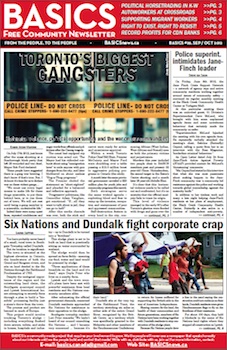
by S. da Silva – 28 February 2011.
February 28 is not just the anniversary of Canada’s invasion and military occupation of Haiti, and the kidnapping of Jean-Bertrand Aristide (Feb 28, 2004). It’s the anniversary of an colonial struggle against Canadian imperialism within Canada’s (illegitimate) borders. On February 28, 2006, protesters of the Six Nations reserve began a protest against the unceded land upon which was being constructed the suburban housing development known as the Douglas Creek Estates.
Support for the small protest quickly grew amongst the people of Six Nations, especially after April 20, 2006 O.P.P. raid at the reclamation site which led to the arrest of 21 people. Later that day, hundreds of people from Six Nations reclaimed the site and drove back the police officers.
Five years later, the dispute has yet to be resolved, and reclamation site remains open.
Yesterday, Sunday February 27, a small demonstration was organized by Gary McHale, a long-time outside agitator from Richmond Hill who has worked to turn Caledonia’s white residents against the struggle of the Six Nations people. McHale’s demonstration – more of a media stunt than anything else – had planned to erect a monument at the Douglas Creek Estates that offered an “OPP Apology” and “Six Nations” apology to the people of Caledonia. McHale’s supporters were no more than 15-20 and were outnumbered by some one hundred non-Native supporters from Guelph, Kitchener-Waterloo, Hamilton, and Toronto, including delegations from the United Steelworkers and Canadian Autoworkers.
McHale has worked tirelessly to whip up a rightwing populism that paints the residents of Caledonia as the the victims of Six Nations “terrorists” and “thugs” and victims of the seeming indifference of police forces and the provincial and federal governments to the issue. McHale’s calls for the “rule of law” to be implemented in Caledonia does not include a support for those treaty obligations that Canada and the British Crown have made in the past with Six Nations.
Afterwards, supporters of Six Nations attended a pot-luck at the reclamation site for a couple hours before returning home.
Re-posted from the International League of Peoples’ Struggle
By Prof. Jose Maria Sison, Chairperson, International Coordinating Committee
The International League of Peoples’ Struggle (ILPS) steadfastly stands in solidarity with and supports the peoples of the North African and Middle East countries in their mass uprisings and revolutionary struggles for national liberation and democracy against the autocratic regimes long maintained by imperialist powers and local reactionary classes.
At the same time, the ILPS is keenly aware that the overthrow of a dictator by a rapid spontaneous surge of the masses does not necessarily result in the revolutionary overthrow of the ruling system. In the absence of a strong revolutionary party of the proletariat and revolutionary mass organizations, the imperialist powers and its puppets among the competing political and military factions of the local exploiting classes can arrange a new regime that pretends to be better than the previous one. Read more…
Reposted from the Latin American and Caribbean Solidarity Network.
On February 23, Jorge Vinicio Sosa Orantes will have a bail hearing in a Calgary court. Captured in Lethbridge, Alberta in January, 2011 Sosa Orantes is facing possible extradition to the USA where an indictment there alleges that he participated in carrying out a massacre in the community of Las Dos Erres during Guatemala’s 36 year Internal Armed Conflict. He faces charges in the USA of lying on citizenship forms about his role with the Guatemalan military. Canada has a responsibility in this case to ensure that Sosa Orantes is not released on bail, nor extradited to the USA where he will be tried for lesser crimes.
Jorge Vinicio Sosa Orantes is one of 17 former Kaibiles, a Special Forces unit of the Guatemalan army, charged in relation to the Las Dos Erres massacre. On December 6, 1982, at least 252 unarmed civilians were systematically tortured and killed in the community of Las Dos Erres, in northern Guatemala. Only two children survived. In the years since the massacre, family members of the victims have sought justice, despite many obstacles and threats. The facts of the case are corroborated by the two surviving eyewitnesses, as well as by declassified documents from the US Embassy and evidence unearthed in two exhumations of the remains of the victims. Sosa Orantes is named as one of those who planned the massacre in the testimony of other Kaibiles tried in the case.
The Association for the Families of the Detained and Disappeared in Guatemala (FAMDEGUA) is plaintiff in the case against the Kaibiles and has been providing legal support for the case since investigations began in 1994. In 2000, the legal case against the 17 former Kaibiles was launched. Since then, 45 injunctions have been put forward by the defendants. There have also been numerous threats made against the staff of FAMDEGUA. In 2009, the OAS Inter-American Court on Human Rights ruled that the State of Guatemala was guilty of impeding justice in this case, and in 2010 the Guatemalan Supreme Court of Justice issued arrest warrants for the 17 men charged. Three of them were arrested and are being tried in Guatemala. Three others were arrested for immigration fraud in the United States, for lying on their immigration applications and for committing crimes for which they have not been tried. In 2010, one was convicted, and sentenced to 10 years in prison (the maximum possible sentence). The other two await trial in the United States, though the Guatemalan Attorney General has requested their extradition.
Sosa Orantes is also wanted for immigration fraud in the United States, but fled to Mexico before being captured. In October 2010, the RCMP alerted police in Lethbridge that Sosa Orantes might try to contact family living there. In January 2011, Sosa Orantes left Mexico for Canada and was arrested in Lethbridge on January 18. The United States has requested his detention in anticipation of possible extradition on charges of immigration fraud. He holds Canadian, American, and Guatemalan citizenship.
Sosa Orantes could be investigated here in Canada for crimes against humanity. He also faces charges in Guatemala for crimes against humanity, and his participation in the Las Dos Erres massacre could implicate him in the Guatemala genocide case in Spain. These countries may also seek extradition orders. These cases are at a critical juncture, and it is possible that the family members of those who were tortured and killed in the Las Dos Erres massacre may finally see justice, if Sosa Orantes and others are tried for the participation in the planning and execution of the massacre.
There are strong allegations that Jorge Vinicio Sosa Orantes was involved in the massacre in Las Dos Erres. He must not be released on bail, nor extradited to the United States where he will be tried for lesser crimes. Families of the victims as well as Guatemalan and international organizations are calling on the Canadian government to ensure that he is tried for the crimes that he has allegedly committed.
For more information see the Canadian Centre for International Justice website: http://www.ccij.ca/programs/cases/index.php?WEBYEP_DI=16
KARAPATAN Alliance for the Advancement of People’s Rights
On the fourth year of disappearance of Leo Velasco, an NDFP [National Democratic Front of the Philippines] consultant for the peace talks, her daughter, Lorena “Aya” writes a letter to him as she and other relatives of missing consultants stage a protest action in front of the Armed Forces of the Philippines [AFP].
This is Aya’s letter.
Dear Tatay (Father),
Kamusta? (How are you?)
A few days ago I had a dream about you. I knew you were here because I can almost smell you. We were talking casually when, out of nowhere I asked, “Are you still alive?”
“No,” you said.
My heart was suddenly stabbed. You said something else that I couldn’t comprehend because I was stuck at the word “No.” Then you hugged me like I had never been hugged my whole life. I hugged you back and I cried. Hard.
Then I was awaken by my own sobs.
Were you telling me that I should start accepting that you are gone? Was that a goodbye hug? It pains me to think so. But four years of searching for you is quite an obvious sign that you will never come home. Today is the fourth year of your disappearance, Tatay. There was never a day that I didn’t miss you nor thought of you.
‘Tay, in those four years, you taught me so much. You taught me to continue this struggle even with the heavy heart of missing you. You taught me to use this anguish and turn it into a fuel in seeking for justice. And even without you, you taught me that your principles are worth fighting, and even dying for. You brought me out of my comfort zone and into the frontlines to confront the perpetrators of injustice and repression in our country. You may not be here but my search had brought me closer to you, and the cause that you carried.
Isn’t it ironic that the fourth year of your disappearance is also the time for the renewal of formal peace talks between the National Democratic Front of the Philippines and the Government of the Republic of the Philippines, which you had also worked for. If only the peace talks could surface you and all other missing victims.
Forgive me for not being able to find you yet. Even with the change of administration, disappearances still continue, “desaparecidos” like you are still missing, and perpetrators are still walking free. You are right when you said that it is not the change of administration that will bring significant change in the society but the other way around.
Today, in your fourth year of disappearance, as much as I wanted so bad to forget that you’ve been missing this long, I stand with your photo in front of the institution that abducted you, the Armed Forces of the Philippines, to call for your surfacing and for other victims of enforced disappearances.
Together with other families of “desaparecidos” we will continue to fight against this heinous crime and against a repressive state.
Your disappearance has led me to find more of myself.
It has also led me to continue what you strived for. Nanay (Mother) and Kuya (older brother) are still here, of course, but also, I stand along many others like me, whose loved ones were disappeared by state security forces. I stand with the Filipino masses who continue to seek justice and genuine social changes, to which you and the other “desaparecidos” had committed your lives.
Thank you for teaching me to find courage in all this, if not, I would have driven myself crazy not knowing what to do. Thank you for bringing me closer to the people whom you served for they give me comfort and strength to continue the struggle.
Tay, my heart still hopes that you are still alive and will be able to read this. I am still waiting for your return.
I miss you so much!
Your loving daughter,
Aya
Group also condemns state atrocities and criticizes filing of false charges against Dr. Ilina Sen
FOR IMMEDIATE RELEASE - Free Binayak Sen Campaign, Toronto Chapter
There has been world-wide condemnation of the sentence of life-imprisonment for sedition
handed out to noted human-rights activist and physician Dr. Binayak Sen, along with two other
accused, on Dec 24th, 2010, in the town of Raipur in central India. He was accused of
collaborating with “anti-state forces”.
Dr. Jonathan Fine, founder of Physicians for Human Rights in Cambridge (MA), was in the court
premises in India during the verdict. “I could not help crying when speaking with Binayak’s wife
before and after the verdict was declared,” he said. According to Nobel Laureate economist
Amartya Sen, “…the whole thing seems a ridiculous use of the laws of democratic India”. Read more…
By Surkh Musafir
“After thirty years of corruption, poverty and corruption, we’re telling Mubarak to get out of Egypt now,” says 21-year old Rana.
She is holding a sign condemning Egypt’s unelected president Hosni Mubarak at a rally held in Toronto’s Dundas Square on Saturday, January 29, 2011. Upto 700 Egyptians and allies came out to demonstrate solidarity with the millions of Egyptians rising up against dictatorial rule.
“They are demanding an end to Mubarak’s thirty years of power, of the National Democratic Party and his ruling elite,” says Mostafa Henaway, an activist with Tadamon! (Solidarity! in Arabic) in Montreal, where hundreds have been demonstrating outside the Egyptian consulate for several days. Read more…
On the evening of May 5, 2010, a horrific crime was committed in this city. The terror took place in what was more or less broad daylight, in front of numerous onlookers, off a major street and on the campus of a well-known university.
At around 6:30 pm, a victim fled two assailants who had been harassing him without any provocation at the Keele and Steeles intersection.
He made it to Founders Rd. just off Steeles when his attackers caught up with him. They knocked him to the ground and began to beat him mercilessly in the face and chest.
Despite the victim’s clear disadvantage and cries for help, the attackers called for five of their buddies to join in the frenzy. Read more…
The SIU has cleared the Toronto police of any wrongdoing in 18-year-old Junior Alexander Manon’s death last May. We sought reactions from people in Junior’s community.
We interviewed four residents of the Jane-Finch community, ranging from age 18 to 40, all of whom have been recognized for serving their community in positive mentorship roles and in positive community-based projects and initiatives for youth.
They will all remain anonymous.
“It’s the police investigating the police, what do you expect?
“…It’s like sending a child to their room and having them decide what the punishment should be…. Read more…
We are now in February and for Africans in North America it is a significant month. It is usually observed as Black History Month.
February is taken as an opportunity to acknowledge African people’s struggles and achievements and commemorate significant moments in the fight against white supremacy, capitalism, sexism and other forms of oppression.
Some of us use this month to reflect and rededicate ourselves to the revolutionary or radical African political tradition.
In the spirit of collective self-criticism, are we at the point where Black History Month is due for a name change and focus? Read more…
By Ashley M.
“It’s a day to celebrate solidarity and difference among women” – Jeevini Sivarajah
“International Women’s Day becomes a canvas for our past and current struggles and as such, it becomes an opportunity to learn about our struggle from other perspectives and meet other women allies” – Tzazna Leal
“It’s a time to celebrate women’s victories and to learn from women’s struggles” – Nadeen el Kassem
“Even though challenging systemic norms and oppression is a day to day thing, IWD is a day when we can really bring our issues to the forefronts while highlighting our strengths and celebrating one of the longest and biggest movements of resistance in herstory worldwide. ” – Keerthy
In talking to sisters, International Women’s Day (IWD) means a lot of things, but the resounding message is unified: Mobilize and continue to fight!
The Revolutionary Women’s Collective (RWC), a working class women’s collective, will focus on confronting precarious work and standing in solidarity with our sisters (and brothers) against imperialism. Read more…