That this torture is institutionalized, and not merely a matter of a few ‘bad apples’, is revealed by the complicity of medical staff in covering up the torture, which is attested to by a couple of direct references. Further, as the staff’s response in the attached Information Request form indicates, authorities do not deny that this practice occurs; they only claim that no harm has come to prisoners. Please forward this article to your networks and list-servs so that we can help the inmates of Red Onion State Prison blow the cover off this practice.Due to permanent ligament damage caused by the FBT, my right thumb now spontaneously dislocates under moderate pressure and impacts. A mild tug pulls it right out the knuckle socket. It’s also lost about 25% range of motion at the middle joint.
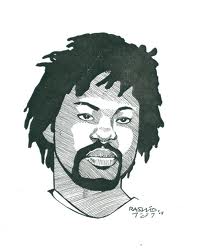
By: Kevin “Rashid” Johnson, 12 September 2011
Some things are just so obvious you don’t need rocket science to figure them out. But those in power will still try and convince you your eyes are lying, your basic sense is failing, and the suffering is just imagination. Routine torture by U.S. officials of poor people of color is a case in point.
I’m going to use the prison setting as an example. Virginia’s Red Onion State Prison in particular.
In her new book, The New Jim Crow,1 civil rights attorney and legal scholar Michelle Alexander exposes modern U.S. mass imprisonment, and the so-called Drug War as the latest phase of ongoing political and racial oppression and containment of New Afrikan (Black) people. She doesn’t, however, talk about the institutionalized sadism, brutality and torture we prisoners suffer under the guise of prison officials maintaining “security,” which is what I want to touch on here.
Breaking Prisoners’ Fingers – A Control Technique?
I want the reader to look at the illustration attached as Exhibit A. Now ask yourself, under what circumstances could bending a human being’s fingers back against the natural band of the joints and knuckles be considered ‘reasonable’ preventive force. And usually it is applied against a person already restrained in handcuffs and shackles.
Imagine this finger-bending technique (FBT) being used against you. It’s terrifying, painful and almost guaranteed to cause permanent injury.
Here at Red Onion the FBT is frequently used, and not merely to subdue a struggling prisoners, but whenever a guard even speculates that a prisoners may be about to become disruptive. And “disruptive’ can mean anything or nothing. The guards have absolute discretion to make the call. All the provocation they need is a sarcastic remark, or being in a foul mood, or resentment against a given prisoner. Often, racial resentment is enough in a prison that pits a 98% rural white staff against an 85% non-white prisoner body.
And how can such a technique be applied with limited or restrained force under the stress and excitement of subduing a struggling person? Especially one who suffers mental health problems. Try it, matter of fact, if you can find a willing partner—preferably someone you can trust not to get too carried away—try it while you’re completely at ease. Your first reflex, like a reaction to having your eyes gouged at, will be to become combative, to resist and pull away. These are instinctive and intelligent responses to the pain, and the protect fragile, sensitive and previous parts of the body. Self preservation.
Ever jammed a finder playing sports? That’s the least amount of pain you’ll fell. And what’s worse, it’s not a brief experience, like jamming a finger. When guards apply the FBT, they don’t let up! The initial grab for your fingers is done suddenly, without warning, and with force, so you don’t have the chance to ball your hands up. The finger bending then continues for minutes at a time. Typically no less than 5 minutes.
And when—not if—you resist in response to the shock and pain, they apply more force often until your fingers touch your wrist. It’s a lose-lost situation. Your options: cry out or suffer silently (both of which eggs them on more), or try and twist away (which increases the risk and extent of injury), or try to fight them off (a highly dubious option, where the victim is typically cuffed behind his back leg-shackled, and contending with multiple guards—all grabbing at and being your fingers and worse).
Often, abusive guards initiate the FBT solely to make a prisoner react. To make him appear belligerent or combative, so greater force is then ‘justified’ to ‘control’ him.
In any case, the result is dislocated and/or broken fingers. I’ve had mine dislocated six times no less. Once for committing the grave offense of questioning guards about racially discriminatory practices against us.
Due to permanent ligament damage caused by the FBT, my right thumb now spontaneously dislocates under moderate pressure and impacts. A mild tug pulls it right out the knuckle socket. It’s also lost about 25% range of motion at the middle joint.
 Official Denials, Cover-ups and Denied Care
Red Onion medical staff generally deny and cover up the injuries their colleagues inflict. Hundreds of prisoners have suffered them. Attendant nerve damage is the norm. In many cases, this results in total loss of sensation in parts of the hand.
A few examples are in order.
On October 27, 2005 Nathaniel Wright had the middle bone of his lift middle finger broken completely in half—courtesy of the FBT. For weeks medical staff told him he was fine, to just apply cold compresses to the grotesque swelling. Only after filing numerous complaints and involving outside prisoner advocates, did he finally receive x-rays revealing his injury.
To repair it, the bone had to be rebroken (because it had begun mending with the severed ends misaligned), surgically reset, held bolted together with screws, and a cast applied to immobilize his finger and hand. To cover up their initial cover-up, Red Onion medical staff claimed Wright broke his own finger sometime after the October 27th incident.
On November 10, 2007 guards beat a restrained prisoner in presence of an entire unit of outraged prisoners, eleven of whom covered their cell door windows in protest. Teams of riot-armored guards were then assembled to forcibly extract all eleven from their cells. Each prisoner, after being tear-gassed, electrocuted, physically subdued and then manacled, had their fingers bent back and dislocated by the guards. Several lost feeling in their hands and suffered permanent damage.
One prisoner, John Gaskins, whose fingers were broken, endured months of writing complaints for x-rays and treatment. When he finally received x-rays, it was too late to be treated, leaving him with permanent deformities and fingers that now chronically dislocate. This is a typical scenario.
Gaskins was recently released from prison in Virginia, and is willing to attest to and show evidence (i.e., his deformed hand) of the brutal FBT. He can be emailed at: johngaskins[at]hotmail[dot]com.
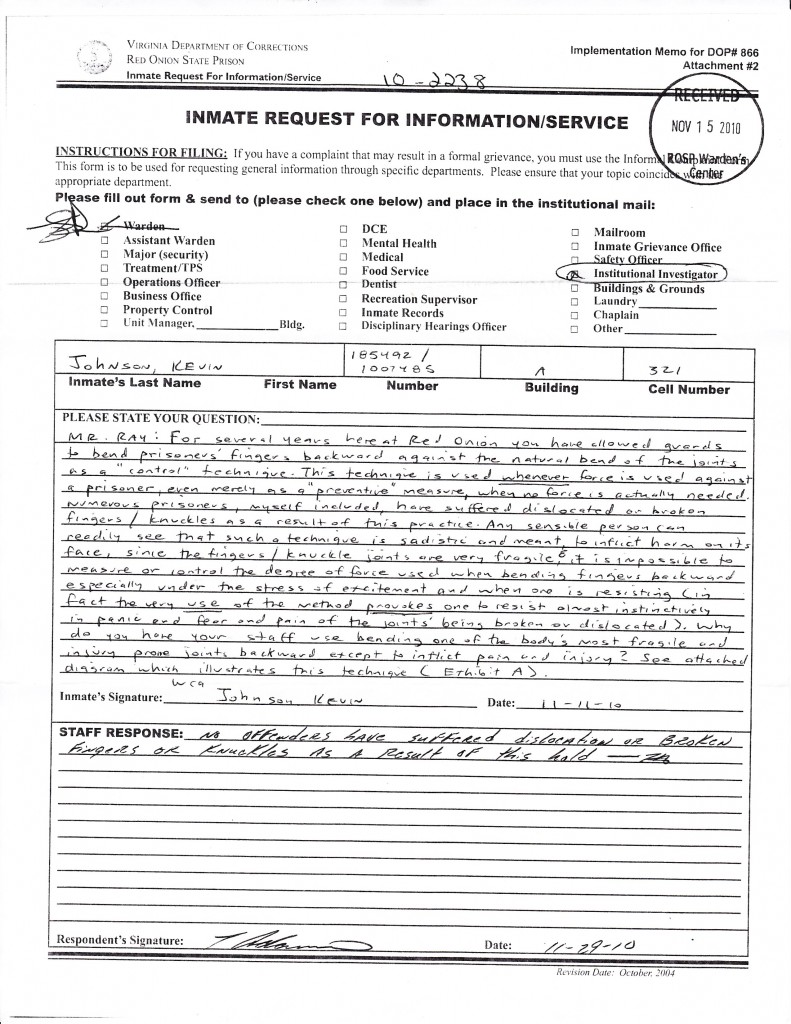
On November 11, 2010 I wrote Red Onion’s warden Tracy S. Ray, asking how the FBT could be deemed anything but sadistic torture and calculated to cause pain and injury. He avoided my request, and passed it on to his notoriously corrupt and deceitful investigator Tony R. Adams. On November 29, 2011 Adams lyingly replied that, “No offenders have suffered dislocation or broken fingers or knuckles as a result of this hold.” (See attached).
Again, it doesn’t take rocket science to recognize that it’s virtually impossible to use such a technique on delicate joins like those of the fingers, and not dislocate or break them. Fingers aren’t pliant like pipecleaners. They bend in only one direction. And it’s impossible to measure or limit the pressure applied when bending fingers backward, especially when one instinctively resists.
And again, try it yourself. Don’t take my word for it. Despite what those in power might say, I assure you, your eyes, senses and agony won’t deceive you.
Plain Old Torture
I can’t imagine that a victim’s panic and pain under waterboarding, genital electro-shock, or thumbscrews could be much worse than the FBT. In more openly barbaric and honest times, (Europe’s Middle—especially Dark—Ages perhaps), the FBT would’ve been called exactly what it is: plain old torture.
So let’s have done with the hypocrisy of U.S. democracy. If prisons are a microcosm of the larger society that births them, what sort of society is it that needs to mass incarcerate millions of its residents, uses mass imprisonment to press and persecute minority nationalities and races of people, and in turn needs to torture them? I’ll tell you what kind…one that still needs to be fundamentally changes.
Dare to struggle Dare to win!
All Power to the People!
by Noaman G. Ali
The Communist Manifesto (Illustrated). Chapter One: Historical Materialism
Edited by George S. Rigakos, illustrated by Red Viktor
29 pages. Red Quill Books. $12.50.
The crew at Red Quill Books has decided to put out a comic book version of Karl Marx and Friedrich Engels’s 1848 text, The Communist Manifesto. That may seem old school but the text seems remarkably fresh, like it was written yesterday, when placed alongside images of our own world today.
For example, we see images of Western UN soldiers handing out aid in an unspecified African country, even as military helicopters bombard villages. Marx and Engels’s text accompanies: “Just as [capitalism] has made the country dependent on the towns, so it has made barbarian and semi-barbarian countries dependent on the civilised countries, nations of peasants on nations of bourgeois, the East on the West.”
The language may be archaic (who they calling barbarian?) but its meaning comes through, especially when placed along the illustrations by Victor Serra (Red Viktor). Without a doubt, the best image is of a human pyramid of class struggle — ordinary folk throughout the ages struggling and climbing atop of rulers and their police forces: “The history of all hitherto existing society is the history of class struggles.”
But the editor, George S. Rigakos, a professor at Carleton University, saw fit to rearrange and trim some of the original words. While trimming might have been okay, throwing the words out of order seems to me to take away from some of the force of how Marx and Engels build their argument step by step. The text in the comic book seems a bit disconnected, rather than something building up.
Also, rather than letting the German revolutionary philosophers speak for themselves, Marx and Engels’s text is preceded by an editorial introduction in two parts. The first is a written piece by Prof. Rigakos which sounds almost apologetic about doing up this comic, given the supposedly repressive history of communism when put in practice — though apologetic, the piece is hopeful about new readers discovering the text. This apology is followed by a lengthy and wordless illustrated sequence where an old school, disillusioned communist activist yells at Marx’s grave in the rain, angry about Stalin and Pol Pot.
By no means should those struggling to build a new and better world avoid examining the sometimes colossal mistakes of actually-existing socialisms in the 20th century (though, even by that standard, Pol Pot’s Cambodia is a far stretch — it was backed by the imperialist United States in war against communist Vietnam). But Prof. Rigakos could have started out the comic by examining the relevance of Marxism and communism as a living and vital force in world politics today, be it the resistance of peoples in Latin America trying to build new socialisms, or the revolutionary communism of the peoples of Nepal, India and the Phillippines.
Instead, Prof. Rigakos gives too much to the current ruling classes who seek to discredit everything about communist movements past and present, trying hard to pretend that Marxism and communism are dead. So it comes down to Prof. Rigakos and Mr. Serra to breathe some new life into it by “reanimating” the text, as he puts it. But that text is already being animated by peoples around the world.
This book is the first of four parts, and hopefully the following parts focus more on what Marx and Engels wrote themselves and the living relevance of Marxism and communism today. Trying to introduce The Communist Manifesto to a new generation of students and youth is definitely a worthwhile effort, and we hope Prof. Rigakos and Mr. Serra are successful in this.
$12.50 is a bit hefty when your average monthly comic goes for $3 or $4 (and is therefore out of the reach of a lot of working folk), but it is a slickly produced, full-colour book by a small publisher and part of the proceeds go to supporting student scholarships. So if you have the money and like radical comics, you might want to get the four parts as they come out. Definitely grab a hold of the comic books from a library.
BASICS Community News Service - Published Sep. 2011
“The national oppression of indigenous people in the Cordillera has reached ethnocidal proportions” - Simon 'Ka Filiw' Naogsan, Spokesperson of the Cordillera People's Democratic Front (Image of Ka Filiw with Steve da Silva of BASICS, in Mountain Province).
On August 1, 2011, journalist Steve da Silva with the people’s media organizations BASICS Community News Service (Toronto, Canada) interviewed Simon ‘Ka Filiw’ Naogson, the Chairperson of the Cordillera People’s Democratic Front (CPDF), an underground and revolutionary mass alliance of indigenous people and organizations in the Cordillera region and a member organization of the National Democratic Front of the Philippines.
Ka Filiw discussed the increasing militarization, mining plunder, and national oppression facing the indigenous people of the Cordillera as the US-Aquino regime approves more mining concessions for the region and consequently intensifies its Oplan Bayanihan counter-insurgency campaign to repress the revolutionary movement.
The interview with Ka Filiw was conducted in the western region of Mountain Province, Cordillera in an undisclosed location, given the underground status of Ka Filiw’s activities. It was conducted as part of a forthcoming book by Steve da Silva, People’s War in the Cordillera, an in-depth look at the people’s resistance and revolutionary struggle in from the vantage point of one region in Mountain Province, Cordillera within the overall context of the revolutionary movement in the Philippines.
Art from 'Ka Libre' of the Leonardo Pacsi Command (Mountain Province) of the New People's Army. The eight spears of the CPDF logo represents the eight ethno-linguistic tribes that make up the Igorot indigenous people.
Steve da Silva / BASICS: Can you tell us what Cordillera People’s Democratic Front (CPDF) is, including its relationship to the people’s struggles in Cordillera, and to the broader revolutionary movement in the Philippines?
Ka Filiw / CPDF: The CPDF was founded in 1981, it launched its Political Congress in 1987, and its Organizational Congress in 1989 and ever since then it has been in operation. The CPDF is the revolutionary united front of all the national minorities and non-minorities in the Cordillera. There are three features of the CPDF. First, it stands as the National Democratic Front in the Cordillera. Second, it as an alliance of all revolutionary mass organizations in the Cordillera. Third, it acts as the people’s revolutionary government in areas where the revolutionary movement is building and consolidating.
The revolutionary struggles being launched by the CPDF in the Cordillera is closely linked with the National Democratic Revolution. First and foremost, because we are all Filipinos. We cannot detach the struggles of the Cordillera peoples and the indigenous peoples from the struggles of the Filipino peoples. Such being the case, our revolutionary struggle here in the Cordillera is directly linked with the National Democratic Revolution. Of course, secondarily, we are waging a struggle to address the historical national oppression suffered by the national minorities and indigenous people here in the Cordillera. Read more…
by Steve da Silva, BASICS Community News Service (Published September 2011) www.basicsnews.ca
On August 13, 2011, BASICS interviewed Gwendolyn Longid, an indigenous Igorot activist and a leading organizer with the Cordillera People’s Alliance in Sagada, Mountain Province. We discussed the struggles of the Cordillera people against imperialist mining plunder and the U.S.-Aquino regime’s militarization of the region under the banner of its ‘Oplan Bayanihan’ counter-insurgency scheme. Longid also explained the difference between the bogus ‘autonomy’ that the national government is trying to impose upon indigenous people versus the genuine self-determination and defense of ancestral domain that the peoples of the Cordillera are struggling for.
This interview is part of the research for a forthcoming book by Steve da Silva, People’s War in the Cordillera, an in-depth look at the people’s resistance and revolutionary movement in the Cordillera within the overall context of the revolutionary movement in the Philippines.
Steve da Silva / BASICS: Can you briefly describe the structure and political work of the Cordillera People’s Alliance?
Gwendoyln Longid / CPA: We have a General Assembly that is made up of members from different provinces and chapters and it elects our Executive Committee. We also have chapters in Kalinga, Benguet, Baguio City, Mountain Province, and Abra, each of which also has its own Executive Committees. We are both a mass organization and an alliance, since we have not only organizations who are part of the CPA but also individuals. CPA Mountain Province has a membership of 37 people’s organization in over 10 municipalities, as well as several other IP [indigenous people's] advocates.
The political work of the CPA is for the defense of our ancestral land and our self-determination. Since the early 1960s when ‘national minorities’ of the Cordillera first faced the threats of the Chico River Dam Projects under the US-Marcos Dictatorship, the CPA has been working to empower indigenous peoples.
Aerial view of the Sagada rice terraces. The rice terraces of the Cordillera are recognized UNESCO world heritage sites for their masterful feats in engineering and agricultural.
From the point of view of the national government, all land with a slope of over 18% or 10.2º degrees is declared public land, making 81.4% of the land in the Cordillera state-owned, or at least that’s their claim. Of course, the indigenous people have a very different point of view on this, considering this is their ancestral land. So the CPA is struggling to defend this ancestral lands. Read more…
Statement from ILPS-Canada – 11 September 2011
The International League of People’s Struggle – Canada, with 22 member mass organizations across the country, joins with millions of working people around the globe in commemorating the tenth anniversary of the September 11 attacks which claimed the lives of 3000 people, including 24 Canadians. It condemns this horrific attack on civilians and stands with the families of the victims and all working people in denouncing this terrorist act.
ILPS-Canada is a country Chapter of the International League of Peoples’ Struggle, made up of more than 200 organizations from 40 countries promoting, supporting and developing the anti-imperialist struggles of the peoples of the world. It has a broad mass character and is not subordinate to any political party, government or religion and affords equality to all participating organizations.
ILPS-Canada also firmly condemns the U.S.-led “war on terror” that was unleashed over the past decade, using 9/11 as a pretext, by the most powerful military force in the world and its allies including Canada, against all those who stand opposed to imperialist expansion and oppression. This war has led to thousands of times the number of deaths in New York, along with the most massive military spending the world has ever seen. It has become a world war without an apparent end, replacing the previous “Cold War” against Communism.
A decade after 9/11, following the invasion of Iraq and Afghanistan and all the other “anti-terror” operations including the killing of Al-Qaeda mastermind, Osama Bin Laden, the world should be, according to Washington and Ottawa, a safer and quieter place. Instead, we find ourselves in a world of political turmoil, catastrophic wars and ecological and economic crisis, with U.S. imperialism vainly attempting to halt its decline and the crisis of monopoly capitalism that is rapidly deepening.
During the opening decade of the 21st century we have seen Canada’s role shift internationally from that of an imperialist “peace keeper” into a front-line war maker and military occupier. And internally, in the same vein of supposedly fighting “terrorism”, the Canadian government has been stepping up repression, particularly against Muslims, those opposed to the crimes and exploitation of imperialism, the indigenous peoples, and the poor. The majority Conservative government is about to re-institute repressive “anti-terror” laws that expired in 2007, a move sure to please the U.S. “Republicrats”.
With U.S. forces overstretched in Iraq, Afghanistan and other such areas, the Canadian government and ruling elite have been stepping in to take up the slack. Billions of our dollars is being spent on military armaments, fighter planes, and new troops instead of schools, health care and job creation at home. The Canadian military is now planning to set up permanent military presence in up to seven countries including Senegal, South Korea, Kenya, Singapore and Kuwait, along with Germany and Jamaica. In our back yard, more billions are being spent on expanding the police forces and prisons, at a time when all experts agree that major crime is decreasing.
In Haiti, Canadian troops are clearly seen as “occupiers” and around the globe Canadian mining companies are confronted by people’s movements, especially indigenous populations, for their aggressive actions and destruction of the environment for short term profit. Some 80% of new mining operations world-wide involve Canadian companies. Canada is now home to the most polluting industrial operation in the world in the Alberta oil sands, oil which flows south to feed the U.S. war machine. Our government’s best friends are brutal regimes like Israel and Columbia, and Ottawa supports coup d’états in states like Honduras and genocidal attacks against the Tamil population in Sri Lanka. Now a Canadian military man has led the NATO attack and occupation of oil-rich Libya, a form of imperialist expansion referred to as “humanitarian imperialism” that is becoming more and more prevalent. All these actions come with almost no noise from the so-called opposition parties, including the New Democratic Party.
Enough is enough; we say no to Canadian imperialism, we say no to attacks on millions of innocent civilians by NATO and other imperialist groupings in the name of this false “war on terror”. We say no to what is in fact a war of terror without end. Almost ten years ago, one hundred and fifty thousand people took to the streets of Montreal, joined by hundreds of thousands of other protesters across Canada and around the globe in similar and related actions, during preparations for the U.S.-led invasion of Iraq. In the face of such mass mobilizations and resistance, the Canadian government was forced to back down from participating in that specific imperialist aggression.
It is time to build a mass anti-imperialist movement against the Canadian government’s new role as a front-line imperialist aggressor, war maker and occupier. ILPS-Canada signals its intent to work with all working and freedom loving people to expose, oppose and fight against imperialism, and particularly Canadian imperialism. However, we do not target just one element of Canadian imperialism, but expose and target clearly the systemic roots of this militarism and expansionism in Canada’s monopoly capitalist system.
We oppose the terrorists who took the lives of innocents in 2001, but we also firmly oppose the even bigger danger to the world’s peoples, the imperialist terrorists, including the government of Canada, who are destroying and endangering the future of the toiling people of the entire globe.
On this solemn occasion we remember those who died on September 11, 2001. ILPS-Canada says:
Down with Canadian imperialism!
Down with all imperialism!
Canada out of NATO!
Canada, withdraw troops and stop military involvement in Afghanistan, Libya, Haiti and other countries around the globe!
We stand for a world in which there is peace with justice and true democracy and freedom from all forms of exploitation and oppression.
ILPS-Canada Coordinating Committee, September 11, 2011
By Prof. JOSE MARIA SISON
ILPS Chairperson
We, the International League of People’s Struggle (ILPS), join the entire people of the world in commemorating the tenth anniversary of the September 11 terrorist attacks which claimed the lives of nearly 3,000 people in the United States. In no uncertain terms, we strongly condemn these horrendous attacks on civilians and al Qaeda as the self-admitted perpetrator. We stand in solidarity with all the victims, their families and the entire people in denouncing and opposing terrorism of whatever scale.
9/11 is a blowback on US imperialism. The US has long promoted Islamic fundamentalism as an ideological and political weapon against communism as well as against secular nationalism, especially since the Cold War. Al Qaeda emerged from the Islamic fundamentalists who were used by the US against the Soviet Union in Afghanistan but who subsequently became disgruntled with the US after Soviet occupation ended. It has vowed to combat the US and its imperialist allies for their policies and acts of plunder and aggression victimizing Islamic peoples and countries.
Instead of being remorseful for fostering Islamic fundamentalism and the ground for al Qaeda, the US has used the attacks on the Twin Towers in New York City and the Pentagon as pretext for terrorism on a far greater scale under the policy of “global war on terror”. This has generated state terrorism and wars of aggression and had inflicted atrocities of monstrous proportions on peoples and countries worldwide. For the last ten years, we have witnessed the lopsided contest of two monstrosities, the mega-terrorism of the US and NATO powers, and the mini-terrorism of al Qaeda.
The US policy of “global war on terror”, designed as a “perpetual” and “borderless” war, is in fact a global war of terror against the people of the world and against anti-imperialist and democratic forces. It has resulted in millions of civilian deaths and the destruction of social infrastructure. The US and its imperialist allies have seized 9/11 as the opportunity to justify and use wars of aggression and expansionism as a means to counter the ever-deepening crisis of monopoly capitalism.
9/11 has given rise to the doctrine of “pre-emptive first strike” used by the US to invade Afghanistan in 2001 and Iraq in 2002. It has been invoked by the US to declare countries like Iraq, Iran and North Korea as the “axis of evil”; and to vilify Libya (up to 2004), Syria and Cuba in the same vein. These countries have been in the crosshairs of the US military machine. They are the target of war threats and provocations, psychological warfare and special operations, vilification by the corporate mass media, political and diplomatic isolation, economic and trade sanctions.
The US has complemented its open wars of aggression with various forms of military intervention, including highprofile and low-profile killings of opponents in various countries, rendition and torture, the recruitment, training, arming and financing of puppet armed units and joint military operations with them. In connection with these, US Special Forces and CIA operatives are deployed in 120 countries and are carrying out a “special war”.
The US imperialists have encroached on the territory of other countries and engaged in drone attacks on civilian populations as in Pakistan, the permanent stationing of US forces and covert US combat and related operations as in the Philippines and the opening of new US military bases, forward stations and other installations as in a number of countries in Central Asia, Latin America and elsewhere. The number and deployment of US Special Forces under the Joint Special Operations Command (JSOC) have increased significantly under the regime of Obama.
So-called anti-terror legislation such as the USA PATRIOT Act as well as the designation of groups and individuals as “foreign terrorists” has also followed the 9/11 attacks. The PATRIOT Act legitimizes violations of the rights and civil liberties of the American people. It allows limitless surveillance, warrantless arrests and indeterminate detention without charges in the name of security. Hard-won civil and political liberties and constitutional rights of the people long established in bourgeois jurisprudence are set aside or violated with impunity in the name of countering “terrorism”. The PATRIOT Act has set the pattern for developing the legal infrastructure for fascism on a global scale.
Detention facilities similar to Guantanamo prison and Abu Ghraib have been established in many countries for detaining suspected terrorists and “unlawful combatants” of different nationalities indefinitely without charges. Torture and murder have been committed, especially in secret CIA prisons across the world. The US, with or without the connivance or consent of host governments, have carried out rendition operations in many parts of the world whereby alleged suspected terrorists are covertly abducted and brought to secret detention centers for interrogation, torture and indefinite detention.
National liberation movements, anti-imperialist leaders and even law-abiding Islamic organizations and charitable foundations have been designated as “terrorist” and subjected to political persecution, including arbitrary arrests, trumped-up charges, freezing of assets, denial of political refugee status and related protection and deprivation of social benefits, as well public defamation and incitement to violence on tpersons labeled as “terrorist”. Under the aegis of the US-led war of terror, the United Nations, the International Criminal Court and the international monopoly media have been used as instruments and willing accomplices to justify wars of aggression and crimes against humanity.
While condemning the 9/11 attacks on civilians, the ILPS also condemns the far more destructive and vicious war of terror being waged by the US and its allies in the name of fighting “terrorism”. This war of terror is nothing less than the unrelenting attempts by US imperialism to impose political, military, socio-economic and cultural hegemony on the peoples of the world through the use of military might. The wars of aggression and military occupation of Afghanistan, Iraq and now Libya have brought about far larger civilian casualties than the original 9/11 attacks. The US-NATO global war of terror has masqueraded as humanitarian intervention, protection of civilians and defense of human rights to kill and maim great numbers of people.
In his inhuman and bizarre way, al Qaeda’s Osama bin Laden has been extremely successful in provoking and bringing out the unbridled aggressive and terrorist character of imperialism. Even his killing, considered by the US as a major victory in its so-called war on terror, has served to whet the appetite of the US and its NATO partners for worse acts of mega-terrorism. It is also quite ironical that the US and NATO have once more connived with the al Qaeda through its branch, the Libyan Islamic Fighting Group, against the Gaddafi government, thus utterly exposing the “war on terror” as a monstrous and murderous lie.
Estimates show that since 9/11 the US has already spent as much as $4 trillion to fund its wars, occupation and intervention worldwide. The US government under Bush and subsequently Obama, has delivered hundreds of billions of dollars to the US military-industrial complex while reducing spending for social services, entitlements and benefits. The gargantuan military spending of the US is one of the immediate causes of the current US debt crisis.
Ten years after 9/11, the US finds itself bogged down in a historic debt crisis and protracted global depression. Its military forces are overstretched and pinned down in several theaters of war around the globe. The US retains more than 150,000 troops in Afghanistan and Iraq and is now engaged with NATO in a war of aggression in Libya.
Over the past decade, anti-war, anti-imperialist and armed revolutionary movements have risen to resist the US wars of aggression. The American people have repeatedly manifested their opposition to the use of 9/11 for justifying wars of aggression. They have pressed for the withdrawal of troops from Iraq and Afghanistan while protesting the huge military spending at the expense of real economic recovery, state subsidies and social services.
The peoples of Iraq, Afghanistan, Libya and Palestine continue to wage armed resistance to US-led and US-sponsored occupation and aggression. Revolutionary and progressive movements in Asia, Latin America and Africa are at the forefront of the people’s struggles for national and social liberation. Countries like Cuba, People’s Democratic Republic of Korea and Venezuela are asserting their sovereignty against US threats of aggression. Exploited and oppressed peoples in both imperialist and dominated countries are advancing the struggle against imperialist wars and for redirecting resources to jobs, livelihood, fair wages and social welfare.
It is imperative that the peoples of the world wage militant and sustained struggles against the US and NATO wars of aggression, state terrorism and counter-revolution. It is only through the struggle of the people that the people can hope to eliminate all forms of terrorism and achieve a new and better world of greater freedom, democracy, social justice, all-round development and world peace.
by Gwendolyn Longid (Cordillera People’s Alliance) – 9 September, 2011
Defying the approaching Typhoon Mina on August 26th, a dozen community activists and grassroots journalists from the Sagada region of Mountain Province in the Cordillera, Philippines came together for a day-long seminar on the foundations of community radio broadcasting. The workshop was attended by members of the Sagada Environmental Guides Association (SEGA), Sagada Genuine Guides Association (SAGGAS), the Cordillera Highland Agricultural Resource Management Program (CHARMP), the Montañosa Research and Development Center (MRDC), and the Cordillera Disaster Response and Development Services (CorDis RDS), along with Radyo Sagada staff and volunteers. The activity was conducted through the initiative of Cordillera Peoples Alliance of Mountain Province and CorDis RDS, and was facilitated by Steve Da Silva of BASICS Community News Service, a people’s media organization from Canada that has a radio program on CHRY 105.5. in Toronto, Ontario, along with a regularly produced newspaper. BASICS carried out the workshop as part of a project of their own known as the School of People’s Journalism.
The day-long seminar was geared towards providing basic skills in community broadcasting for the various sectors and organizations in Sagada. The day’s activities covered technical aspects as well as the principles of community radio, with an emphasis on what distinguishes a people’s media organization from commercial radio. Da Silva from BASICS stressed that “a community media organization that doesn’t recognize that its heart and soul is the community – is the people – will very quickly find itself looking like commercial radio or dying out. If the corporate media served the people’s true interests and addressed their needs, then we wouldn’t need to create a people’s media apparatus.”
The participants engaged in various worshops and formats throughout the day. Gareth Likigan and Ben Calpi of SAGGAS role-played a mock interview with a student who does part time work as a tourist guide to meet ends meet. Others simulated a round table discussion focused on Sagada as a tourist hotspot. Brenda and Gaodan Angway of SEGA did a review on Sagada culture done by Brenda of Radyo Sagada and Gaodan Angway of SEGA. All participants were challenged in the art of improvisation – such as through simulated phone-in questions – a feature of radio broadcasting that sets it apart from other forms of media.
Through the activity, the organizers hoped to encourage more organizations to take on time slots at the recently formed Radyo Sagada station. The SAGGAS intend to have a radio show which delves on environmental issues. The SEGA has so far shared in the weekly program on solid waste management and regular volunteer work as anchor and newscasters at the radio.
Steve da Silva of BASICS Community News Service spent over a month in Mountain Province researching people’s struggles and indigenous struggles for self-determination against foreign mining companies and militarization. Da Silva, who was in the Philippines for the 4th International Assembly of the International League of People’s Struggles in Manila in early July, also joined Radyo Sagada for a series of interviews discussing some of the links between Canadian imperialism and the Philippines. From August 23-25, da Silva joined hosts Ma Karl, Habibi, and others for a series of back-to-back-to-back interviews, one on Canada’s notorious record of genocidal policies towards indigenous peoples in Canada, which continue up to the present day. “If the Canadian state can carry out a genocide of indigenous peoples in the present day right in its own country, then how do you think Canada is going to operate abroad when it confronts other indigenous or colonized peoples, such as the Igorot people here in the Cordillera.” Another discussion dealt with the widespread human rights violations associated with the overseas operation of Canadian mining companies, which also operate in the Cordillera, such the corporation Ivanhoe, which is heavily invested in Benguet-based Lepanto Mining.
On the final day, the interview covered the links between Canadian ‘development’ aggression around the world and the migrant worker programs in Canada that so many Filipinos and others around the world are trying to get in to. The conversation drew attention to how the policies of neoliberal globalization which displace peoples from their homelands create large pools of cheap labour for imperialist countries like Canada. The programs discussed included Canada’s Live-In Caregivers, the Seasonal Agriculatural Workers, and Temporary Foreign Workers.
The torrential rains that began to fall at the day’s end did not put a damper on the event, which ended on a high note with a lively discussion on the challenges but necessity of building a genuine community media organization from the ground up and through the people.
Writing and researching for BASICS Community News Service while in Mountain Province, Steve da Silva has a number of pieces coming out on the Cordillera that will be published at www.basicsnews.ca throughout the month of September 2011.
Montreal | BASICS – 11 September 2011
by Steve da Silva
The death of some three thousand civilians ten years ago can no longer be claimed by the imperialists as a pretext for their endless War on Terror’. Ten years on, the world is no safer from terror – certainly not the state-sponsored terror. Not only have the wars in Iraq, Afghanistan, and Libya claimed 100 times the lives of the September 11 attack, but the NATO imperialists’ shameless war in Libya – in which they helped usher into power al-Qaida elements (Libyan Islamic Fighting Group) and other unscrupulous paramilitary forces – reveals that Islamic terror groups are not the true targets of the imperialist wars of the last decade.
Here in Canada today, this was the message of anti-imperialist forces who rallied to register their dissent to the role of Canadian imperialism in the US-led global war. In Montreal, the Revolutionary Communist Party (RCP) organized a demonstration downtown to protest Canada’s role in the wars in Afghanistan, Libya, and its shameless support for Israeli state-terror against the Palestinians.
Beginning at Cabot Square, the march was attended by some 150 people, weaving north-east through Rue Sainte Catherine and René-Lévesque passing the U.S. Consulate and Canadian Federal Government Guy Favreau Building, burning U.S. and Canadian flags along the way.
While mourning the victims of 9/11, the anti-imperialist coalition ILPS-Canada issued a statement today that also opposed Canada’s role in the War on Terror and the rampant militarism it has unleashed since then: “With U.S. forces overstretched in Iraq, Afghanistan and other such areas, the Canadian government and ruling elite have been stepping in to take up the slack. Billions of our dollars is being spent on military armaments, fighter planes, and new troops instead of schools, health care and job creation at home. The Canadian military is now planning to set up permanent military presence in up to seven countries including Senegal, South Korea, Kenya, Singapore and Kuwait, along with Germany and Jamaica.”
Chilean national heroes Salvador Allende and folk singer Victor Jara in line with images of a small fraction of the thousands of disappeared and executed under the US-backed Pinochet military dictatorship. -Parc Jeanne-Mance, Montreal | Sep 11, 2011
A couple hours earlier, some 50 Chileans and other supporters rallied at Parc Jeanne-Mance in the Plateau area of Montréal to commemorate another grave act of terror carried out on September 11…1973: The US-sponsored coup d’etat in Chile. Chilean-Quebecers rallied to mourn the torture, disappearance and execution of the thousands in Chile after the 1973 coup, which is the event that triggered the large exodus of Chilean refugees to Canada and elsewhere in the world.
This article was compiled from news releases and statements from the Jun Tae-il Labor Movement Institute and the Global Campaign to Save Jeju Island. Reworked for publication by BASICS.
7 September, 2011
On September 2, police were deployed to Gangjeong Village in the Jeju Island municipality of Seogwipo to break up a blockade by villagers against the long-sought construction of a naval base. At around 5:10 a.m., Seogwipo Police Station sent around 600 officers into Gangjeong Village, where the base is due to be built, to surround and seal off Jungdeok Junction, which was occupied by 80-100 villagers and activists. The police stated that they had deployed force in order to prevent acts obstructing construction work because the navy had resumed construction early that morning, sending in excavators to the site.
Protesters clashed with police, sitting in shoulder-to-shoulder on the road, shouting slogans and blocking the police’s path. Around 38 people, including two priests, were reportedly taken away by police.
The raid came days after the Jeju District Court gave ordered the protesters off the site, giving them one week to voluntarily remove their barricades and other obstructions at the stalled building site. The court ruled in favor of the Navy, which has been seeking to build an additional base in Jeju Island since 1993, by accepting an injunction that the government filed to strictly prohibit protestors occupation of the 480,000-square-meter area. The court made it clear that should demonstrators disturb the construction project worth 978 billion won ($920 million), they will be slapped with a 2-million-won fine each time.
The Navy aims to make the base home to some 20 vessels, including submarines and two 150,000-ton cruise ships.
The once peaceful town with a population of 1,900 has been split in two since it hastily decided to propose hosting the naval base in an ad-hoc meeting in April 2007 without proper consultation with residents or knowledge about the consequences.
Hundreds of residents have been fighting to reverse the villages earlier position by impeaching then-village leader Yoon Tae-jeong and voting on the issue. Gangjeong villagers dismissed Yoon in August 2007, after 416 of 436 residents cast
ballots supporting his removal.
Ten days later, the town held a referendum where 94 percent opposed the base. Of 725 people who participated, 680 voted against the hosting the naval base. Only 36 supported it while nine votes were void. The government and Navy,
however, only recognized the first vote, angering those opposing the naval base.
The military claims that Gangjeong was designated as a naval base as the majority of the villagers supported the plan and there is a growing need to counter a possible territorial dispute with China over Ieodo, a submerged reef south of Jeju. The Navy also claims that the Jeju naval unit would help the nation respond promptly to possible conflicts in the shipping lane in the southern sea, through which 98 percent of the trade-dependent nations cargo passes.
On September 3, an ‘Airplane of Peace’ carrying 300 people from the mainland and 22 ‘Buses of Peace’ from other villages of Jeju Island gathered in the Gangjeong Stream Stadium for “Play, play, Gangjeong—Peace Concert” and kept the peace in Gangjeong Village through non-violent, peaceful actions. Around 2,000 people urged cessation of construction of the base by holding cultural events.
All participants from all over the country from all parts of the society flew to Gangjeong Village in Seogwipo city by plane and bus cried out in chorus for peace. The other villagers in Jeju Island and the Peace Plane participants successfully completed the event. Politicians who joined the event made a promise to conduct parliamentary inspection about the construction of the naval base at Gangjeong. Although the Gureombi Coast symbolic of Gangjeong village was blocked by the fence, it remained in the hearts of Gangjeong villagers.
Gangjeong villagers are calling for international support in resisting the construction of the naval base. The following statement is from the Gangjeong Village Association:
Official Statement of Appeal
We appeal to peace advocates worldwide to give Gangjeong residents and its peace
activists international support and solidarity to stop the Jeju naval
base construction. Please spread the news of these problems related to
the Jeju naval base construction with your networks and show us your
support and solidarity.
The Joongduk coast of Gangjeong Village in Jeju Island is now suffering.
In 2006, Jeju Island was designated as an Island
of Peace for the purpose of consoling the deep sorrow of the April 3rd
Massacre. And the Joongduk coast was appointed as a Biosphere Reserve,
World Heritage Site, and Global Geological Park by UNESCO. It is an
Absolute Preservation Area, which is now being threatened by the naval
base construction.
Insisting that the naval base is vital for national security, the Korean
government and the navy are enforcing the construction. However, the
Ocean Navy expansion plan–upon which the base construction was
justified–has been discarded in revisions to the national defense bill
regarding strategies to counteract recent security threats.
This leaves no justification for this new base. In addition, the original argument
from the government when the National Assembly budget bill was passed was
to construct a Joint Civil Military site to be used for tourism as well
as military purposes.
However, that plan has disappeared and now only the
military base is being constructed. By maintaining military alliances
with Japan, Australia, South Korea, and India, and through joint military
exercises with the Philippines, Vietnam, and Taiwan, the U.S. is
attempting to build up its defense line against China.
If the Jeju naval base is constructed, the U.S., which possesses the right to station there
according to the ROK-U.S. Mutual Defense Agreement, will surely use this
base to stand up against China. In that case, Jeju Island, an Island of
Peace, will become a center of military conflict between the U.S. and
China, jeopardizing South Koreas national security.
Government and military authorities, however, are turning a blind eye to
the voices of Gangjeong residents and civil peace activists, as well as
to the demands to suspend the construction coming from the opposition
parties and the investigation committee of the National Assembly.
The navy has even used violence against a protesting civilian. On July 11,
the national government recommended that the city government barricade a
farm road on the Joongduk coast, which is the last remaining piece of
state-owned land under the jurisdiction of Seogwipo city within the site
of the naval base construction.
This action was a response to the demand from the Ministry of National Defense to discourage any attempts to stage a protest against the naval base construction. However, such efforts by the government to enforce the construction only bring about stronger
resistance and conflicts from Gangjeong residents and peace activists.
The construction must be stopped before any unfortunate accidents take
place. We appeal to the government and military authorities.
The argument for the base construction by the government and the navy is no longer
valid. Moreover, the means and procedures used to promote the
construction have been so violent and deceptive that they are only
causing more resistance and resentment. Unilaterally pushing ahead with
the construction, in the name of the national project, is obviously not a
wise way.
We call upon the government and military authorities to
withdraw their plan to close the farm road and to completely reexamine
the Jeju naval base construction project.We appeal to Woo Keun-Min, Jeju
governor.
Governor Woo, you were aware of the negative consequences that
could result from the naval base construction and you were right. We urge
you to give up the futile illusion about the development profit and to
listen to the desperate voices of the residents.
We further request you to use your authority to cancel the removal of the absolute
preservation area designation of Joongduk coast. If you do so, history
would remember you as a person who protects the peace of Jeju and the
Korean peninsula.
We appeal to the national assemblyAs an entity representing citizens,
the national assembly has a duty to listen to and respond
to citizens voices.
We appeal to the opposition parties to be more active in nullifying the Jeju naval base construction project. The Grand National Party, as the current ruling party, should seriously
examine whether the base is really needed and whether national budget
should be spent on inflating military forces and feeding construction
capital.We appeal to citizensGangjeong citizens have been fighting alone
for over four long years.
In the meantime, the village community has been
torn apart, leaving indelible scars. Citizens are also engulfed with
fears due to various lawsuits from the government and construction
companies, as well as fines up to tens of millions of won. They are
suffering from the fact that the Goorungbi boulder, which represents
their dreams and memories, might be covered with cement block.
Please express your solidarity and give them your consolation. And if you can,
please visit Gangjeong Village. Then you might be able to understand more
clearly why the construction must be stopped.
In addition, please use your wisdom and energy to do whatever you can in your position to prevent the Jeju naval base construction.We appeal to peace advocates worldwideInternational support, advocacy, and solidarity to stop the Jeju naval base
construction give Gangjeong residents and peace activists strength and
courage.
Please spread the news of these problems related to the Jeju
naval base construction with your networks and show us your support and
solidarity.
We will try our best to prevent the Jeju naval base
construction, which endangers the Korean peninsula and Northeast Asia,
and which is destroying the lives of Gangjeong residents and the natural
environment, a gift from heaven.
We firmly believe that this struggle is our responsibility to Jeju Island,
where the sorrow of the April 3rd massacre is deeply embedded,
that this is an expression of our conscience
regarding the suffering Gangjeong residents, and that it is the demand of
the times to protect and ensure peace for our children.
We sincerely appeal to everybody who stands alongside us to protect Gangjeong Village
and Jeju Island.
Ms. Gang, Young-silThe Gangjeong Village Association
Email: [email protected]
Telephone number +82-11-9826-5022
Website: http://savejejuisland.org/Save_Jeju_Island/Welcome.html
by Cynthia Palmaria – August 2011
“Advance the Global Anti-imperialist Women’s Movement! Strengthen the International Women’s Alliance!” – this was the theme of International Women’s Alliance First General Assembly, held in the Philippines last July 5-6, 2011. Realized just three years after IWA’s conception at the 2008 Hong Kong conference of the International League of People’s Struggles (ILPS) when it was passed as resolution #7 by the Women’s Commission, and taking place just a year after the 2010 Montreal Founding Assembly, the 2011 First General Assembly was a testimony to the enthusiasm all over the world for its development.
The Manila General Assembly was a resounding success in many senses. The numbers were outstanding: 99 women from 20 countries, representing 67 organizations. Two representatives of GABRIELA-Ontario were able to participate through the co-sponsorhip of the Women of Steel of the United Steelworkers, OPIRG-York University and OPIRG-Toronto. The event also marked the formation of an international alliance of these grassroots organizations. Above all, this was a landmark move of women from many nationalities, classes and perspectives to advance together in developing an international women’s anti-imperialist movement.
On the morning of July 5th, IWA delegates attended a joint event held with the International Migrant’s Alliance, the International Conference on Progressive Culture, and the RESIST! conference, which were all part of the International Festival of People’s Rights and Struggles. This event opened the four conferences with a ritual headed by a Cordillera leader and a joint cultural performance highlighting the different sectors of society such as women, workers, peasants, youth, indigenous, migrants, professionals and their struggle against the various forms of imperialism. Opening speeches were then heard from a panel of experts on Gender Rights and Women’s Struggles: Lina Solano of Ecuador , Azra Sayeed of Pakistan, and summed up by Antonio Tujan of IBON Foundation, a research organization. After the opening keynotes, the women marched to commence the assembly.
The IWA conference hall was decorated with colorful banners and “banderitas” (paper buntings), gaily marking the first general assembly of the alliance. Contagious camaraderie and solidarity ruled the day as the women rolled up their sleeves and eagerly went to work vowing to move ever forward together. The heat in Manila was no match to the burning sentiments at the conference, and militancy marked statements and cultural expressions. Songs were sung in different languages such as Tagalog, English, French, German, Dutch and Spanish. Throughout the 2-day conference, the cultural wing of GABRIELA-Philippines, Sining Lila (Purple Art) never failed to amaze us as the artists rendered songs of women, workers, peasants and migrants with one unifying theme: rising up to fight back.
For the two historical days, delegates from different regions worked diligently in workshops wherein they agreed on the general program of action which was to be the content of the of a four-year plan of action. The body then voted for the first set of officers that represented different parts of the world. Having agreed on the resolutions, the assembly also adopted the Manila Declaration of Unity of the International Women’s Alliance which called for a global militant, anti-imperialist women’s movement that will “link ourselves and our struggles to fight our common enemy-imperialism and feudalism including patriarchy, to stop the economic and political domination of the capitalist system, and to end imperialist wars of aggression and measures against the oppressed peoples of the world.
The assembly elected the following officers:
In order to celebrate and recognize the highly-valued contributions of militant women leaders, the assembly looked back with respect into women’s history and honored some of the women for devoting their lives for the emancipation of women. The ‘Women of Valor’ awards were given to participants such as Carmen ‘Nanay Mameng’ Deunida, leader of the urban poor organization called ‘Kalipunan ng Damayang Mahihirap (SAMAKANA)’ from the Philippines, Edith Ballantyne of the Women’s International League for Peace and Freedom of Canada, Leila Khaled of the General Union of Palestinian women of Palestine and Clelia Iscaro of National Encounters of Women from Argentina.
At the close of the conference, the delegates representing women of the 21st century vowed that as they went back to each of the countries they lived in, they would all continue to move forward the struggles of women. This time, they would move together, forging unity every step of the way as an anti-imperialist, anti-patriarchy, anti-racist, anti-sexist and anti-homophobic militant women’s international alliance. Ever stronger this way, each one envisioned a great movement surging forward towards gender equality and the emancipation of women everywhere, strongly linked with the people’s movement for national and social liberation.