by Kevin Edmonds
Imperialist Canada
By Todd Gordon
432 pages. Arbeiter Ring Publishing. $24.95 ($16.46 from online retailers).
Most Canadians tend to view our country as a force for good in the world — we have even been subjected to beer commercials trying to convince us that we are a nation of peacekeepers, not soldiers.
by Kelsey Mowatt – OpenMedia.ca
While the Conservative government may have shelved its Internet surveillance legislation for the time-being – thanks in no small part to the 75,000 folks who have signed OpenMedia.ca’s StopOnlineSpying petition – it’s important for Canadians to stay on top of this issue. The legislation received little to no democratic feedback or committee oversight to begin with, and Public Safety Minister Vic Toews has gone on record stating that the “legislation will come.” In other dramatic and often stated words, the battle has been won, but the war has just begun….
Despite repeated claims from the government that their proposed “Lawful Access” legislation does not infringe on the privacy rights of Canadians, all of Canada’s Privacy Commissioners, including Federal Commissioner Jennifer Stoddart, oppose the agenda. In October, Ontario’s Information and Privacy Commissioner Ann Cavoukian wrote an openletter to Toews himself, and compared the government’s legislation to “enacting a highly intrusive surveillance regime.”
The Conservative government’s online spying agenda would grant authorities warrantless access to Canadians’ personal information, including address, phone number, e-mail address, Internet protocol address, and device identification numbers.
While on the surface this may seem innocent enough, many privacy and surveillance experts have warned that authorities could use this information to compile an extensive and invasive record of anyone’s online activities without judicial oversight. In addition, this aggregated data would reflect any and all Internet activity that is tied to these numbers and addresses, meaning the privacy invasion may extend to people who authorities don’t even seek to watch.
Now if you, your friend, or co-worker, isn’t worried about things like online privacy, the security of your personal and or financial information, then you might be asking, “what’s really the big deal?” After all, if you have “nothing to hide”, then what’s the problem right?
Well, aside from the issue of your civil liberties, there is the problem of what the government’s proposed Internet surveillance will cost you the consumer.
Several Internet experts and civil rights advocates, like the Canadian Civil Liberties Association, have publicly acknowledged that the implementation of such legislation will likely cost millions of dollars. Will the cost of enacting and purchasing this online spying technology fall on the public purse? Or will it be passed on to ISPs themselves, which in turn, will be shifted on to you to take yet another bite out of your bank account? And all this during less-than-certain economic times…
What will be the financial impact of government-mandated Internet surveillance on smaller ISPs? These are additional costs that, as Tom Copeland, head of chair of the Canadian Association of Internet Providers (CAIP) has gone onrecord saying, could potentially put some smaller ISPs out of business. Canadian consumers need more competition for Big Telecom, not less.
While the Conservative government has put its online spying agenda on the back burner for now, OpenMedia.ca needs your continued support to make sure this legislation doesn’t rear its invasive and costly head again.
Kelsey Mowatt is a researcher with OpenMedia.ca
Indigenous leaders from the Kitchenuhmaykoosib Inninuwug (K.I.) First Nation community drew over one hundred attentive listeners on the evening of November 22 for a downtown community event as they presented their case for the defense and future of their lands and environment in the face of their newest adversary, a mining corporation that goes by the name God’s Lake Resources.
Located about 600 km north of Thunder Bay, K.I. is a fly-in community of pristine boreal forests, waters, and wetlands. Big Trout Lake (661 sq. km) is central to the life of these Oji-Cree people. The closest urban centre is Sioux Lookout, hundreds of kilometres to the south. Like so many northern Nations, the population is relatively impoverished, and the community infrastructure largely inadequate or sub-standard. Typical also of such communities, there is a substantial corporate interest exploiting their land-based resources.
K.I. Chief Danny Morris opened the community event and K.I. Spokesperon John Cutfeet filled in the history and details for the presentation at the Ryerson Student Centre as part of the program for Indigenous Sovereignty Week. Chief Morris along with five others (to become known as the K.I. Six) were imprisoned in 2008 for defending their territory from Platinex, a mining company with platinum prospects in the K.I. territory. They were subsequently released when in July of 2008 the Ontario Court of Appeal overturned their sentences.
Platinex was found to be in operation on K.I. territory in 2006 without any prior consultation with K.I. representatives. An interim injunction was obtained by the K.I. First Nation with the intention of working out some mutually viable arrangement, but after being worn out bureaucratically and fiscally by the demands of an oppressively lop-sided Ontario-Platinex agenda, K.I. decided it could no longer continue the process. Soon after withdrawing from the process, the courts awarded Platinex “immediate and free access to the territory” and the infamous stand-off ensued. Eventually, the Ontario government paid off Platinex to the tune of $5 million plus mediation and legal fees to pack up and end the ordeal.
Presumably as some lip-service to this debacle, the Government of Ontario promised a reform of the Mining Act (which is as yet unavailable) and they introduced the Far North Act, which spelled out the necessary consultation requirements with First Nations for any prospecting or developments on First Nations jurisdiction. One might assume, as Cutfeet suggested, that the Far North Act was developed precisely because the federal government knows that it has no legal jurisdiction on most First Nation territory. In response to the K.I. filing of a land claim, however, the Ontario government stated that the entitlement claim “was tenuous at best…and without merit”.
Much of the debate over land entitlement goes back to the James Bay Treaty of 1905, known as Treaty 9. The Crown likes to assert that this Treaty is clearly defined by a notion of “cede and surrender” while in actuality there is not even an equivalent word for “cede” in the Cree native language. As a simultaneous translator by profession, John Cutfeet should know. He said that even today, he is hard-pressed to translate such terminology as “cede and surrender” for there is really no equivalent terminology in their language, and he insists that the elders of the community, by their oral tradition and life experience, offer no recollection of ever giving up the land. They rather insist that all agreements in fact assumed a continued relationship and steward of their land, in co-existence with the colonial government.
By this time the K.I. had had enough of government and corporate agendas challenging their land rights and destabilizing their community. In an impressive surge of sovereignty they conducted a referendum for their nation on July 5, 2011 that overwhelmingly approved their Water Declaration and Consultation Protocol. The referendum was approved by 96% of ballots cast. Under the Water Declaration, thirteen thousand square miles of watershed were announced as being autonomously protected and declared untouchable by industry. The Consultation Protocol established a process by which outside interests must conduct themselves in negotiations with the K.I. for land-use. While groups like the Council of Canadians and Greenpeace signed on to their Declaration, it was virtually ignored by the Canadian Government.
And then along came God’s Lake Resources. In a surprisingly arrogant insult to the K.I. people they initiated exploration a short crow’s fly from Big Trout Lake in pristine watersheds and threatening the site of a sacred burial ground with at least 31 graves and more in the surrounding area.
On November 14, 2011 the K.I. broke talks with the Ontario government after it became clear that there was not a mutual and sincere dedication to a proposed resolution via a KI-Ontario joint panel, as the Ontario government was unwilling to impose an immediate halt to the mining comopany’s explorations while the panel ensued. K.I. issued a press release with the inclusion of the following statement:
“We need a reasonable process to protect our sacred areas. That process cannot take place without assurances that GLR will not access the land and where the sites are. We cannot talk with your government while GLR desecrates.”
During his introduction, Chief Donny Morris contemplated the scenario with the company: “We don’t know if it’s going down that same road, where it wants a pay-out from Ontario, …this is something that we have to try and prevent too – that’s a sure way for a company to get a quick pay-out, to use us that way…” And with an election on the horizon at the time, one has to wonder if there wasn’t some deliberate scheming for such a consolation prize.
Regardless of motive, the K.I. are faced now with a serious threat from a mining corporation that seems intent on desecrating their territory, clearly in defiance to prior Supreme Court jurisprudence which deemed essential some due “consultation, negotiation, accommodation and reconciliation” with the community (this from the July 2008 Ontario Court of Appeal decision overturning the prison sentences of the K.I. Six).
Chief Morris made no bones about his hope and intention of expanding the K.I. cause to activists and others in our region: “We are moving forward, we’re looking for support … we’re looking at all avenues, we’re not going to stop half-way now, we’re going to go all the way … and here in the GTA, that’s where our support is …”
For more information on how you can help: http://kilands.org
GROUP STATEMENT BY 17 PEOPLE CHARGED WITH CONSPIRACY DURING THE G20 REGARDING A PLEA DEAL
Pat Cadorette, Erik Lankin, Paul Sauder, Meghan Lankin, Bill Vandreil, Joanna Adamiak, Julia Kerr, David Prychitka, Alex Hundert, Monica Peters, Sterling Stutz, Leah Henderson, Adam Lewis, Mandy Hiscocks, Peter Hopperton, SK Hussan, Terrance Luscombe
Individual statements by all 17 will soon appear on the website conspiretoresist.ca. If you would like to issue a solidarity statement in support, please email [email protected].
November 22, 2011 — As people across Turtle Island look towards the global wave of protests against the austerity agenda, the memory of the 2010 G20 protests in Toronto looms large as both inspiration and caution. We are seventeen people accused by the state of planning to disrupt the leaders summit – the prosecutors call us the G20 Main Conspiracy Group.
This alleged conspiracy is absurd. We were never all part of any one group, we didn’t all organize together, and our political backgrounds are all different. Some of us met for the first time in jail. What we do have in common is that we, like many others, are passionate about creating communities of resistance.
Separately and together, we work with movements against colonialism, capitalism, borders, patriarchy, white supremacy, ableism, hetero/cis-normativity, and environmental destruction. These are movements for radical change, and they represent real alternatives to existing power structures. It is for this reason that we were targeted by the state.
Although these conspiracy charges have been a big part of our daily reality for the past year and a half, we have been slow in speaking out collectively. This is partly because of the restrictive bail conditions that were placed on us, including non-association with our co-accused and many of our close allies. In addition, those of us who did speak out have been subjected to a campaign of intimidation and harassment by the police and prosecutors. We are writing now because we have negotiated a plea deal to resolve our charges and to bring this spectacle to an end.
The state’s strategy after the G20 has been to cast a wide net over those who mobilized against the summit (over 1, 000 detained and over 300 charged) and then to single out those they perceived to be leaders. Being accused of conspiracy is a surreal, bureaucratic nightmare that few political organizers have experienced in this country, but unfortunately it is becoming more common. We can’t say with any certainty if what we did was in fact an illegal conspiracy. Ultimately though, whether or not our organizing fits into the hypocritical and oppressive confines of the law isn’t what’s important. This is a political prosecution. The government made a political decision to spend millions of dollars to surveil and infiltrate anarchist, Indigenous solidarity, and migrant justice organizing over several years. After that kind of investment, what sort of justice are we to expect?
We have not been powerless in this process; however any leverage we’ve had has not come from the legal system, but from making decisions collectively. This has been a priority throughout, particularly in the last several months, as the preliminary inquiry gradually took a back seat to negotiations for a deal to end it. The consensus process has been at times a heart-wrenching, thoughtful, gruelling, disappointing, and inspiring experience, and in the end, we got through it together.
Of the seventeen of us, six will be pleading and the eleven others will have their charges withdrawn. Alex Hundert, and Mandy Hiscocks are each pleading to one count of counselling mischief over $5,000 and one count of counselling to obstruct police, and Leah Henderson, Peter Hopperton, Erik Lankin, and Adam Lewis are each pleading to a single count of counselling mischief over $5,000. We are expecting sentences to range between 6 and 24 months, and all will get some credit for time already served in jail and on house arrest.
Three defendants in this case had their charges withdrawn earlier and one has already taken a plea to counselling mischief over $5,000 that involved no further jail time. This means that out of twenty-one people in the supposed G20 Main Conspiracy Group, only seven were convicted of anything, and none were convicted of conspiracy. The total of fourteen withdrawals demonstrates the tenuous nature of the charges.
This system targets many groups of people including racialized, impoverished and Indigenous communities, those with precarious immigration status, and those dealing with mental health and addiction. The kinds of violence that we have experienced, such as the pre-dawn raids, the strip-searches, the surveillance, and pre-sentence incarceration happen all the time. The seventeen of us have moved through the legal system with a lot of privilege and support. This includes greater access to
“acceptable” sureties, and the financial means to support ourselves and our case. While the use of conspiracy charges against such a large group of political organizers is noteworthy, these tactics of repression are used against other targeted communities every day.
There is no victory in the courts. The legal system is and always has been a political tool used against groups deemed undesirable or who refuse to co-operate with the state. It exists to protect Canada’s colonial and capitalist social structure. It is also deeply individualistic and expensive. This system is designed to break up communities and turn
friends against each other.
Within this winless situation, we decided that the best course of action was to clearly identify our goals and needs and then to explore our options. Within our group, we faced different levels of risk if convicted, and so we began with the agreement that our top priority was to avoid any deportations. Other key goals we reached were to minimize the number of convictions, to honour people’s individual needs, and to be mindful of how our decisions affect our broader movements. Although we are giving up some important things by not going to trial, this deal achieves specific goals that we weren’t willing to gamble.
Our conversations have always been advised by concern for the broader political impacts of our choices. One noteworthy outcome is that there are no conspiracy convictions emerging from this case, thus avoiding the creation of a dangerous legal precedent that would in effect criminalize routine tasks like facilitation. Taking this deal also frees up community resources that have been embroiled in this legal process.
We emerge from this united and in solidarity.
To those who took us in while on house arrest, to those who raised money for our legal and living expenses, to those who cooked food, wrote letters, offered rides and supported us politically and emotionally throughout, thank you.
To those in jail or still on charges from the anti-G20 protests, to political prisoners and prisoners in struggle, we are still with you.
To communities and neighbourhoods fighting back from Cairo to London, from Greece to Chile, in Occupied Turtle Island and beyond, see you in the streets.
On Monday, November 7, BASICS correspondent Steve da Silva linked up with the Filipino-American MC Bambu for an interview after the Blue Scholars show in downtown Toronto. Bambu is from Los Angeles and has been producing for almost a decade with the likes of MC Kiwi, DJ Phatrick, Power Struggle and many others. In the Fall of 2010, Bambu, through Soul Assassins, released the “Los Angeles, Philippines” mixtape with the legendary DJ Muggs (Cypress Hill). Before 2011, the mixtape had already hit over 100,000 downloads. His LPs include ‘self entitled’, ‘exact change’, ‘i scream bars for the people’, and ‘paper cuts’. Here’s what the ‘Kasama’ [comrade in Tagalog] had to say to BASICS…
Steve da Silva / BASICS: How does the national liberation movement in the Philippines relate to the music you’re producing in America?
Bambu: There’s a clear line between the two. Like I said on stage, all my music really does is raise the awareness of the people and the consciousness of the masses. It’s a tool used to organize. The goal is to get those people who like the music to actually go out and organize. That’s where I separate myself from the actual work that’s going on.
Now, if you wanna talk about my organizing, then yeah, I am also doing work in organizing and educating folks, especially within the youth sector, basically building a bridge between what’s going on here and what’s going on back in the Philippines. What we like to say is connecting the ‘micro’ to the ‘macro’. We’re trying to get the youth we’re working with – youth of colour, Filipino youth – to bridge what’s going on in the community with what’s going on back at home and around the globe. Read more…
New workshop series on indigenous history coming out of Barrio Nuevo
by Santiago Escobar
This past October 12, the First Indian Film Festival was kicked off in Toronto to commemorate the Day of Indigenous Resistance.
From the perspective of the celebrants of European colonialism, October 12, 1492 is viewed as the day Columbus ‘discovered’ the American continent. From the perspective of the colonized, those civilizations and societies in the ‘Americas’ that were more populous than Western Europe in 1492 (100 million people by some accounts), this day marks the beginning of the most atrocious crime in world history: the beginning of history’s greatest genocide. The mass killing of millions of indigenous peoples, followed by the mass enslavement and trade of Africans, went hand-in-hand with the destruction of an untold number of societies that were stripped of their territories, beliefs and social organization. So it was only appropriate that this past October 12 be the day chosen for the First Indian Film Festival to be kicked off.
We mark the 519 years since the beginning of Indigenous Resistance as the victims of European colonization are still paying the price for the dismantling and looting of our already established societies at the hands of those who boasted of having ‘discovered’ the new world. We continue to pay the price for the geographic ignorance of the sailors who accompanied Christopher Columbus on his adventure in search for shorter routes to the Indies (Asia) from Europe.
The colonization and marginalization of our peoples, especially indigenous people, persists into the present. No one can doubt that we are advancing in the fight for true freedom, true independence, and we are now seeing the emergence of progressive governments throughout South America reflecting the accumulation of indigenous peoples’ struggles. But it is still a long way to achieve the desired independence and true freedom.
The Toronto screenings created a space for debate and reflection about the struggles of the indigenous peoples of Central and South America. It must be noted that the films presented were 100% produced and created by indigenous people, transmitting their worldview without intermediaries and without distorting the indigenous and popular struggles. This point is important to stress because normally these kinds of documentaries are produced by foreigners, who are distant to the reality of daily life of indigenous people. Foreigners tend to tell these stories from a liberal perspective and are inclined to represent the Indians as an almost magical subject, perfect, or as a folkloric and romanticized object, ignorant of the deeper meaning of their struggles, which is against colonialism and imperialism – or as it is popularly known, globalization.’ Many of these liberal perspectives overlook or disregard the significance and centrality of the organizational and social formations of indigenous people’s – a basis for the success and achievements of many of these people’s movements.
The attendance during the film festival was vast and generated an awakening of awareness, especially among the Latin American audiences. It created consciousness for public struggles in an historical and cultural context, related to the living spaces claimed by fellow Indians of Central and South America.
The documentaries shown were accompanied by follow-up discussions and analyses from the audience with the aim of understanding and exchanging ideas about indigenous struggles. Recognizing the need to learn more about Central and South American history, the audience unanimously supported the development of a series of workshops dealing with indigenous peoples before the Spanish conquest, during the conquest, throughout the period of the nominally ‘independent’ neo-colonial republics, and the last 30 years of resistance by the indigenous peoples and other social movements from Mexico to Patagonia.
With this wide support from the Latin@ community, we will soon be starting an educational series to address these topics.
To register for this workshop series please write to us at [email protected].
On Saturday, November 19, 2011, BASICS caught up with John ‘Mac’ Gaskins, the Minister of Information of the New Afrikan Black Panther Party (NABPP)‡, at a speaking event at Burning Books in Buffalo, New York. After spending nearly half his life in prison, the young Panther is now out on the streets and is part of a new generation of young revolutionaries carrying forward the legacy of the original Black Panther Party in the present. (Radio Basics also interviewed John ‘Mac’ Gaskins back on October 3, 2011 about ongoing practices of torture that he and others have experienced at Red Onion State Prison in Virginia. To download that interview, click here). Steve da Silva / BASICS: You were telling us tonight how you spent half of your life in prison – after catching some cases when you were younger. Here you are now, 31 years of age and on the outside as revolutionary and a New Afrikan Black Panther. Can you briefly recount how you arrived at where you’re at today?“What’s Mao’s little Red Book gonna mean to a mother who can’t put food in her children’s stomachs tonight?”
John ‘Mac’ Gaskins: Well, my story doesn’t differ much from most guys raised in urban settings. I’m from Richmond, Virginia, and born into a single-parent home. My mother is from the bottom of the working-class. As a kid, I would watch my mother go to work, working two jobs that were never enough to secure the basic necessities for me and my sister. So early on I decided that I had a distinct role to fulfill. At about the age of ten, I had this friend who taught me how to go into stores, open up the food products and eat and drink until we got full and exited the store. But eventually, I realized that this wasn’t doing anything to help my family. So I actually started stealing products, bringing them out of the store and to my family so we could prepare meals. As this went on, the activity just progressed until I got into robberies. But I had certain moral compunctions from the start though. I never robbed a common working-class person, old ladies, anything like that. It was drug dealers, commercial establishments, and people that I felt like they were criminals themselves, either pumping poison into the community or people who have these commercial establishments in the community but don’t live in our communities and are only extracting funds from us. Ultimately, over time though I would take on some traits of an illegitimate capitalist, and this would ultimately lead me to prison at the age of 17.
My incarceration would actually begin before this though. I started going to jail when I was about 14, I spent about 2 ½ years in “Juvie” (Juvenile Detention). So that was preppin’ me for what was coming in the future, these 14 years that I would spend in prison. So ultimately I went to prison and I would endure all the practices that take place there, everything from having my fingers broken to being bit by dogs, to being strapped to a bed for days and being forced to defecate and urinate on myself. I would go without meals for days at a time, my mail was being hindered. Not having access to a telephone. I was at these “Supermax” prisons out in the mountains and I didn’t get visits. My family couldn’t afford to come visit me. I was feeling every ounce of the weight of this system and this was for me where the political education began. Read more…
by Corrie Sakaluk – A PERSONAL REFLECTION
Over two months since the first Occupy Wall Street protest took place in New York City, and in the face of incredible police violence, protestors are still keeping to the courage of their convictions, holding their ground, and gathering daily.
What started on Wall Street has also spread far and wide: Toronto, Edmonton, Montreal, Vancouver, Los Angeles, Seattle, San Francisco, Cleveland, Orlando, Dallas, Kansas City, Portland, Atlanta, Phoenix, Chicago, Madison, London, Athens, Madrid, Barcelona, Stuttgart, Amsterdam, Tel Aviv, Algiers, Tokyo, Sydney….I’m not sure if this is even all of them. Read more…
by Megan Kinch – Reposted from toronto.mediacoop.ca
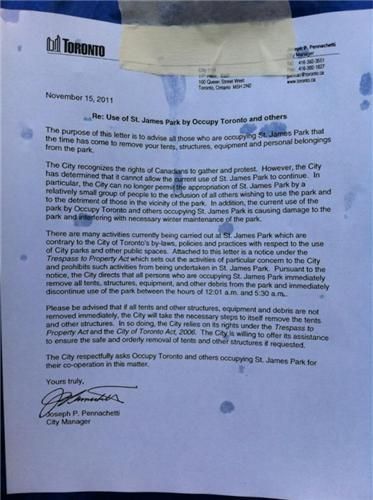
The City says “The City recognizes the rights of Canadians to gather and protest. However, the City has determined that it cannot allow the current us of St. James Park to continue. In particular, the City can no longer permit the appropriation of St. James Park by a relatively small group of people to the exclusion of all others wishing to use the park and to the detriment of of those in the vicinity of the park. In addition, the current use of the park by Occupy Toronto and others occupying St. James Park is causing damage to the park and interfering with necessary winter maintenance of the park.”
There is a second page to the notice serving official notification of trespass.
Occupiers have been receiving support from thousands of Torontonians, as well as many local residents and local businesses, and have offered to co-operate fully with city staff in winter maintenance. In the minds of protesters and many in the city, this eviction is political.
The City threatens to remove tents and structures as of 12:05 tonight. Please join with occupiers at 11 PM tonight in the defence of our civil liberties and right to create space to build an alternative society.
Stay tuned to this site for updates as we get them (this story will be updated shortly as more information comes in), and to the official occupy toronto site at http://occupyto.org/
Intensify the peoples struggle against imperialism at the G20 Summit and beyond!
Press statement of Commission 1 of the International League of People’s Struggles
November 3, 2011
On Nov. 3-4, the heads of government of the largest imperialist powers led by the US together with the world’s largest emerging economies will gather at Cannes, France for the G20 (Group of 20) Summit. The meeting is part of the ongoing attempts of the imperialist powers to stem the still raging global financial and economic crisis that is now being characterized by the exploding public debt crisis in the US and several European countries.
As declared by the current French presidency of the G20, the summit in Cannes will supposedly seek to conclude the existing actions
designed to tackle the root causes of the crisis. Furthermore, the G20 Summit, which will also bring together the Finance ministers and heads of central banks, intends as well to broaden its agenda to include new actions aimed at sustainably improving global stability and prosperity.
Anti-imperialist and democratic forces around the world must expose the deception that the spinmeisters of the G20 are concocting
about the reparability of the bankrupt global capitalist system. The so-called existing actions to address the root causes of the crisis have been nothing but futile attempts to conceal the progressive decay of an economic system that thrives on the private appropriation of massive profits by the few while the great majority suffers from untold poverty and misery.
Worse, efforts to address the crisis, in particular the use of trillions of dollars in peoples money to bail out the biggest banks
and corporations from the crisis that they themselves created, have only further stoked up the burgeoning debts and deficits of the monopoly capitalist states, already bloated by the costly and discredited war on terror campaign.
Yet the people continue to shoulder the burden of the global financial and economic crisis. After losing their homes and
jobs, the people have been forced to carry the weight of the austerity measures being implemented by governments to tame their respective public debts and deficits. Of particular and immediate concern is the euro zone debt crisis, wherein European leaders, the International Monetary Fund (IMF), and the private creditors have agreed recently to implement a 50% cut in Greek government bond investments to reduce Greeces debt burden by €100 billion and avoid a debt default. Greece was also given a fresh $11 billion in bailout funds.
The G20 Summit is expected to extol these moves, as well as the deal to scale up the regions bailout fund, the European Financial Stability Facility (EFSF), to as much as €1 trillion from €440 billion last year. The imperialists hope that it will be enough to stave off the worsening of the debt problems in the euro zone, specifically of Italy and Spain. But all this comes at the expense of the people who face deep austerity measures including tax hikes, depressed wages, cutbacks on pensions and social benefits, reduced social services and increased fees, and declining public sector employment, among others.
The meeting in Cannes will certainly be used to push for additional austerity measures to sustain the momentum of the all-out attack on peoples rights and welfare in the name of saving the putrid monopoly capitalist system. At the same time, the imperialist powers continue to wage costly wars of aggression that squander their peoples money and resources and end up in the mass murder of resisting forces and the civilian population as well as the destruction of physical and social infrastructure in their target countries.
The upcoming G20 Summit in particular will be held at a time when the US and its allies in the North Atlantic Treaty Organization (NATO) are rejoicing over their successful military intervention in Libya that culminated in the barbaric killing of Muammar Qaddafi. They are sure to trumpet this victory which they achieved using the usual justification of defending democracy and the
people but in reality is barefaced intervention to control the worlds resources and establish the most reliable puppet regimes to serve the imperialist agenda.
However, the imperialist crisis and wars will only feed the peoples growing struggle and resistance against imperialism that enslaves, oppresses, and exploits them. This is evident in the explosion of peoples protests in the US, Europe, Latin America, Asia and the rest of the world against the austerity measures, bank and corporate bailouts, the greed of Wall Street and other financial firms, and against imperialist plunder and wars of aggression.
Thus, the International League of Peoples Struggle (ILPS) Commission 1 calls on all anti-imperialist and democratic forces around the world to wage all forms of resistance especially mass protest actions in light of the G20 Summit in Cannes, France and to sustain and intensify our struggle to replace the rotting system of monopoly capitalism with socialism wherein genuine sovereignty, democracy, and economic development can be realized.#
Renato Reyes
Secretary General
New Patriotic Alliance (Bayan) – Philippines