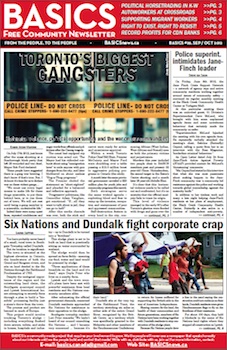
by Tony Couto
In the immediate aftermath of the July 16 shootings on Danzig St. in Scarborough, Toronto Mayor Rob Ford took the airwaves on AM640 and in his predictably racist and idiotic style pledged “to find out how our immigration laws work” so he could expel those convicted of gun crimes in Toronto: “I don’t care if you’re an immigrant or not, if you get caught with a gun, I want to find out the legalities of are you allowed to stay here or are you not… I’m sure it falls under some sort of immigration law.”
Ford’s remarks would have been laughable were they not echoing the disturbing trend of the Federal government to link crime (speciously) to immigration. Take for instance Federal Bill C-43, what is being called the “Faster Removal of Foreign Criminals Act”. If passed, this legislation would allow for the deportation of any non-citizen who has received a sentence of six months or more for any crime carrying a ten-year maximum sentence, beefing up the Conservatives’ anti-immigrant and anti-refugee arsenal of laws.
Harper and Ford in front of a Parm Gill sign, the MP who introduced the private member’s bill that would make it a crime to recruit someone to a “gang”.
Ford the anti-tax crusader also seized upon the Danzig incident as an opportunity to express his opposition to social programming: “I don’t believe in these programs – I call them hug-a-thug programs.” So, the users of community arts and sports programs in Toronto’s designated “priority neighbourhoods” are all thugs? Ford continued, “[these programs] haven’t been very productive in the past” – arguing through assertion not reason –“and I don’t know why they are continuing with them.” Ford routinely uses the popular appeal of his anti-tax cause – a major factor that got him elected – to attack social spending and attack unions. But when it comes to police spending, however, Ford’s City Hall has no problems throwing billions into the law-and-order abyss.
The official police budget for 2012 was previously projected at $936 million; but as Ford began demanding of Ontario Premier Dalton McGuinty extra funding for police as advisor close to Ford revealed that that Toronto is already spending closer to $1.2 billion on policing. On July 23, McGuinty technically declined Ford’s request for $5-10 million to fund new officers, but he did the next best thing for the pro-cop agenda by pledging to permanently fund the so-called Toronto Anti-Violence Intervention Strategy (TAVIS) to the tune of $5 million a year. McGuinty made himself more palatable to the public than Ford by paying some lip service to social programming and taking a more “balanced approach” to gun violence. But McGuinty’s announcement for the fast tracking of $500,000 through the so-called Safer and Vital Communities Program is not a counter-balance to the more-cops approach: it’s a extension of it.
To receive grants through this program, organizations and agencies must be willing to work with the police. This funding criterion will exclude all those organizations that acknowledge police brutality and profiling/carding in the “priority neighbourhoods” as a serious problem and are unwilling to collaborate with the police as a condition for the provision of social services.
While in Toronto for his July 24 meeting with Mayor Rob Ford at the ‘Gun Summit’, in addition to talking up Bill C-43, Harper defended his general ‘law and order’ agenda: defending elements of his Omnibus Crime Bill that judges have deemed unconstitutional or in violation of the Charter; and promoting a private member’s bill, C-394 (Criminal Organization Recruitment), recently introduced by Conservative MP Parm Gill of Brampton-Springdale. Gill recently said of the proposed legislation that “Criminal organizations today are targeting youth under the age of 12 and as young as 8 years-old to participate in criminal activity… There is a dire need to protect our communities from those who prey on innocent and vulnerable individuals.” What’s objectionable to this bill is not only the provision of the police and the courts with yet another law to criminalize youth; but its emphasis on petty criminal enterprises (would anything but a petty criminal enterprise recruit an 8 year-old?) when there exist much bigger players behind the guns and drugs game.
In a joint public statement from Toronto-based Filipino and Latino community organizations concerning events in the wake of the Danzig shootings, Pablo Vivanco of Barrio Nuevo raised this exact point: “We also need to start asking where these guns are coming from, who is bringing them into this City and why. These youth are not making or smuggling guns, so we need to acknowledge that there are bigger things at play and target the real players in this morbid game.” In this whole debate on gun crime, the giant elephant in the middle of the room that the media, police, and politicians are refusing to acknowledge is the role played by larger criminal syndicates – nothing short of a conspiracy of silence.
The influence of organized crime in Canada has been hitting the headlines in Quebec in recent months with a public inquiry exploring the links between the construction industry, the mafia, and Quebec’s political parties. The assassination of a series of major mob figures in Montreal has also in forced the issue of organized crime back into the mainstream. But are illegal donations to political parties and unfair public contracts the worst of it for the mob these days?
Then there’s the vast network built up by the Hell’s Angels over the last decade. It’s no secret that the Hell’s Angels – on the surface an all-white biker club – fronts for a large criminal network embedded within and around it.
Considering the very existence of large criminal enterprises like these, it isn’t a quantum leap to the arrive at the conclusion that there must be greater forces behind the guns and drugs flooding into and fracturing working-class communities in cities like Toronto. Yet it’s in our communities where the policing and criminalization is concentrated and where the violent scramble for market share plagues youth gang culture.
That impoverished racialized communities end up experiencing the bulk of the violence should come as no surprise when we analyze the socio-economic reality we’re left with: a shrinking pool of jobs for youth and their parents; rising tuition fees of post-secondary education (not to mention the alienating experience of racist curricula and administrators in high schools); rising costs of living; cuts to social programming; and the broad criminalization, profiling, and discrimination of racialized youth that push many out of the job market to begin with. Now throw into this mix of desperate circumstances the prospect of making a quick buck in the petty drug trade made possible by larger criminal syndicates reaching down into “priority neighbourhoods” for candidates to move their product, and what you get is a violent scramble for market share and domination. The big gangsters are getting paid behind the scenes regardless of the violence happening on the ground; and this violence gives the cops a cause for crusade, the politicians an election issue, and big capitalists a sense of security that the armed apparatus of the state is getting stronger and stronger at a time when the masses of people are getting poorer and more desperate.
The tragic shootings on Danzig St. on July 16 should definitely have us asking questions about violence in our communities and searching for solutions. But these questions, and the answers that must follow, are not the ones being posed by Rob Ford, Dalton McGuinty, Bill Blair, and Stephen Harper, these enemies of the people who are exploiting the Danzig tragedy to beef up police forces; peddle their racist, anti-immigrant, anti-people, and anti-social policies. These policies are not solutions to gun violence and crime: they’re desperate measures to stabilize a decaying capitalist society by dividing and containing the people.
The question that remains is how much the law enforcement agencies and politicians actually know about the relationship of larger criminal enterprises to the guns and drugs in our communities. Just for the record, that’s not an appeal to power: it’s an indicment of it.
[Editor note: this article was originally posted on venezuelasolidarity.ca. The Spanish version follows.]
by: Juana Cabezas
Over 50 people convened in Toronto’s Trinity Bellwood Park, site of a bust of South American Liberator Simon Bolivar, as an expression of solidarity with the Venezuelan people and with the Bolivarian Revolution.
In a recent meeting in Caracas, Venezuela, a grouping of continental Left parties and movements calledthe Sao Paulo Forum issued a call for international solidarity for Venezuelan President Hugo Chavez and the Bolivarian revolution to take place around the birthday of Simon Bolivar. The forum also called for more expressions of solidarity and the combatting of a decade-long media campaign against Bolivarian Venezuela that have looked to topple President Chavez and reverse the gains made by Venezuelan people in their political process.
The event included words from Nery Quintero of the Gran Polo Patriotico-Partido Socialista Unido de Venezuela (GPP-PSUV) in Toronto, as well as greetings from Consul General of the Bolivarian Republic of Venezuela in Toronto, Martha Pardo. Numerous participants also read short statements of solidarity, with others reading passages and quotes from Simon Bolivar.
Pablo Vivanco, Barrio Nuevo delegate before the ‘Avanzada Bolivariana campaign’ urged participants to join the campaign especially in the lead up to the October 7th Presidential elections in Venezuela. The Avanzada Bolivariana and PSUV in Toronto will be working to produce materials and other information in order to show the tremendous social, political and economic gains Venezuelans have made and the dangers that are threatening to undo these.
Más de 50 personas se reunieron en el Parque Trnity Bellwood de Toronto, lugar en donde se encuentra el busto del Libertador Simón Bolívar, haciendo una recreación de solidaridad con el pueblo venezolano y con la Revolución Bolivariana.
En la ultima conferencia del Foro de Sao Paulo en Caracas, Venezuela, que agrupa a partidos de izquierda y movimientos sociales de Latinoamerica, se lanzo un llamado Internacional en Solidaridad con el Presidente Hugo Chavez y la Revolución Bolivariana al rededor del natalicio del Libertador Simón Bolívar.
El Foro igualmente llamo a combatir la campana sucia que la media corporativa viene realizando por mas de una década en contra del proceso Bolivariano, que tiene como objetivo el derrocamiento del Presidente Hugo Chavez y los logros conseguidos por el pueblo venezolano.
El evento contó con las palabras de Nery Quintero, representante del Gran Polo Patriótico-Partido Socialista Unido de Venezuela (PSUV-GPP) en Toronto, así como los saludos de la Cónsul General de la República Bolivariana de Venezuela en Toronto, Marta Pardo. Igualmente numerosos participantes leyeron breves declaraciones de solidaridad, además de pasajes y citas del Libertador Simón Bolívar.
Pablo Vivanco representante de Barrio Nuevo ante la campaña ‘Avanzada Bolivariana’ instó a los participantes a unirse a la campaña sobre todo en el periodo previo a las elecciones presidenciales de octubre 7 en Venezuela. La ‘Avanzada Bolivariana’ y el PSUV-Toronto van a trabajar en la producción de materiales informativos sobre los grandes logros conseguidos durante el proceso Bolivariano así como también las amenazan al proceso Revolucionario.
Jane-Finch community leader, activist, and employee of Black Creek Community Health Center, Sabrina ‘Butterfly’ Gopaul was issued a thinly-veiled threat by Superintendant David McLeod of 31 Division on June 8, 2012 at a public meeting that McLeod hijacked and went on to accuse Gopaul of “borderline criminal” behaviour for her statement in an interview with Boss Magazine of her support for “a community led resistance against the police and working towards global comradeship against the austerity knife.”
July 24, 2012
Attention: Toronto Police Services Board
40 College Street
Toronto, Ontario
Canada M5G 2J3
Chair and Board Members;
We want to bring to your attention some very destructive activities by Superintendent Dave McLeod of 31 Division. On Friday, June 8th 2012, the Jane Finch Crisis Support Network convened a meeting of its members at Black Creek Community Health Center, Yorkgate Mall. This is a network of agencies and engaged residents who work together around issues of safety in our community. This was a regular monthly meeting.
Superintendent David McLeod of 31 Division arrived at this meeting. He had not been expressly invited; however, it was assumed that he had been passed on the invitation from a member of the police from a meeting held the previous week. The agenda was set and there were multiple opportunities and offers to people present to add items to the agenda. Superintendent McLeod did not add anything to the agenda.
What followed was a traumatic event for all those present. Superintendent McLeod hijacked the meeting with his own agenda item. He repeatedly verbally attacked the meeting’s chair, Sabrina (Butterfly) Gopaul, calling a quote from her in an interview with the Boss Magazine, “borderline criminal” behaviour. Ms. Gopaul had stated in this interview that what she was most passionate about making happen in the Jane-Finch community was “a community led resistance against the police and working towards global comradeship against the austerity knife.”
Superintendent David McLeod was severe, unrelenting, and intimidating in his manner. Members of the network at the meeting stated on several occasions that this was inappropriate, that this was not the space or time to have this discussion, and that he should stop pursuing this topic, but he continued.
When members stated that she had a Charter Right to freedom of speech, he responded that as a community leader, she did not have that right. He then attempted to tell the group how to do their work, that they should not support Butterfly or this position on the police. In spite of the group’s opposition to his position, he continued to repeat himself.
In spite of his inappropriate behaviour, the other members remained calm, attempted to redirect the conversation, and tried to handle the matter professionally. This did not stop the superintendent, but it did stop any productive discussion. Many members left the meeting when the Superintendent refused to back down. He denied that he was being intimidating even after members had left the room and several others were crying.
Eventually the meeting was adjourned as the chair had no choice but to leave, the network was unable to do any of its work, and everyone there expressed that they felt intimated and bullied.
The actions of Superintendent McLeod at this meeting and at least one other community meeting has shown clearly that he has no understanding of the damage that he is doing in the community. He clearly does not understand the legal principles involved in the Charter of Rights. He demonstrated the lack of skills and professionalism in dealing with the community and he misused the authority and privileges that our city has given him that allow him to have a badge and carry a gun in our neighbourhood.
We believe that your officer, Dave McLeod, is improperly employed in the position of Superintendent of 31 Division or any other similar positions and demand to see him removed from that position as soon as possible.
Background: Ms. Gopaul and many others have seen numerous problems with the police service in our community. We have seen a number of cases where there have been no consequences for officers who abuse their authority on the streets, in their cars and in the station. The result of this has been emotional scaring, lack of trust and resentment towards the police and, in some cases, like Junior Manon,
death. We see our youth afraid to walk the streets of our communities
because of the racial profiling activities of your officers.
Thank you for taking all these serious concern and our demand into
your prompt consideration. We look forward to hearing from you soon.
Sincerely,
Jane-Finch Action Against Poverty (JFAAP)
janefinchactionagainstpoverty@
Jfaap.wordpress.com
416-760-2677
On July 7th, Dundalk residents, Six Nations land defenders, and non-native allies, marched through the town to oppose a hazardous sludge project. The theme of the march was Two Row Wampum in Action.
The first video is from Zach Ruiter of the Toronto Media Co-op. The second is from Camila Uribe of BASICS Community News Service.
by Smadar Carmon
The small village of Susiya in the Israeli Occupied Territories is about to be demolished yet again. But most Canadians have never even heard about the first, second, third and fourth times. But we should know, because Canada is heavily implicated in these human rights abuses as a result of our unconditional support for Israel.
A few years ago some fellow Israelis introduced me to Susiya and its determined and resolute residents. These Israelis have made it their business to work with and support the Palestinians living in the villages of the South Hebron hills.
The elements are harsh in these hills; the scorching heat envelopes you and all you can see is arid land dotted here and there with patches of green. The only lush areas are next to the illegal but fully water-supplied Israeli settlements; while the Palestinians must import and pay dearly for water arriving by truck. Energy is connected for the Jewish settlements, but Palestinian villages have nothing. Recently, my Israeli friends and the Palestinians came up with a way to get power by installing a few small wind turbines and some solar panels. Now at night the residents can read and even use a refrigerator – quite an achievement in the 21st century!
Susiya was razed in 1985, 1991, 1997, and twice in 2001. An adjacent Jewish West Bank settlement of Susiya was built in 1983. In 1986, the Palestinian Susiya was declared an archaeological site as it sits atop remnants of an early Jewish settlement. Its residents were forced to move onto their farmland, into tents and caves. In 2001, the Israeli army (IDF) and Civil Administration, part of the IDF, violently expelled them, destroying their homes, fields, livestock and water cisterns. This was all under the pretense of responding to the second intifada (Palestinian uprising). Following a campaign and legal battle by Palestinian residents and Israeli leftists, the Israeli High Court of Justice instructed authorities to stop the demolitions. But it did not instruct the Civil Administration to allow the Palestinians to build, giving them no other choice but to reconstruct the village without permits.
Throughout the West Bank, East Jerusalem and Gaza, house demolitions are a constant reality for Palestinians. It is estimated that at least 24,813 houses have been demolished since 1967. The Civil Administration routinely discriminates against them by making it their acquisition of building permits almost impossible. Showing the strength and determination they are so recognized for, Susiya residents boldly erected some tents and hovels, including a school.
In spite of the 2001 High Court ruling disallowing further demolitions and other acts of harassment, Jewish settlers and the IDF subjected Palestinian farmers to ongoing violence and blockades of their land. Finally help came from the organization Rabbis for Human Rights; it, along with the residents, filed a complaint regarding their inability to access their land, and the settlers increasing encroachment on it.
In 2011, something unusual occurred: the military commanding officer declared a large part of the Palestinian residents’ land closed to Israelis; this was an attempt to stop the violence and land encroachment by the settlers. To “remedy” this the settlers used the association Regavim to speed up the demolition orders for Susiya’s few meagre structures Regavim’s petition painted a bizarre picture of the two sides Palestinian residents became “illegal outpost settlers” (despite the fact that they have lived there for centuries), and Jewish settlers emerged as indigenous, oppressed and discriminated-against (!).
Outrageously, throughout the court challenges and the Regavim petition the illegal building of the Jewish Susiya continued. As well, the Civil Administration hurried to fly in the face of Israeli law and demolish as much of the Palestinian Susiya as they could before the High Court intervened. On June 13, 2012 they issued demolition orders for 52 buildings, including a preschool, a clinic and a solar panel system.
Susiya is a microcosm of life for Palestinians living under Israeli occupation. The authorities’ obvious discrimination, especially regarding the provision of services, resembles ethnic cleansing. As of today, Palestinians living in the little village of Susiya and elsewhere are under constant threat of demolition, expulsion and forced relocation. It feels like it will never end.
As Canadians we should implore our government to hold Israel to international standards of human rights and not condone their abuses. Let us not leave it to others, such as the current Avaaz.org petition (http://www.avaaz.org/en/
For more information:
http://villagesgroup.
http://villagesgroup.
by Michael Romandel and Megan Kinch. This review only contains mild spoilers as it focuses on the political aspects of Dark Knight Rises rather than plot per se.
The Dark Night Rises is a portrayal of a workers’ revolution from the perspective of the bourgeoisie. It is a profoundly authoritarian movie which includes severe criticisms of revolutionaries, but also liberal democracy, bourgeois charity and the apathetic, ultimately offering a hopeless political vision that only the status quo is tenable and that one should look to ones own personal happiness. Our first thought on leaving the theatre- what kind of society could produce a big-budget movie with such a completely hopeless message about the future of humanity and the inability of ‘the people’ to govern themselves? Neither of us are able to remember a major motion picture made in our lifetimes that was as openly counter-revolutionary and reactionary as this one, though the politics of this movie are built up in the two earlier films of Christopher Nolan’s Batman trilogy and simply culminate here. It seems that this movie is able to be explicitly counter-revolutionary because revolution itself is beginning to come on the agenda in the advanced capitalist world for the first time since the 1970s. Science fiction has often shown resistance and rebellion to fascistic societies, but “Dark Knight Rises” actually defends the dystopian reality that it presents, a reality not far removed at all from our actual present. There was a large and visible security presence at the Scotiabank theatre where we saw the film on Friday night, and people in the line were half afraid/half joking of the possibility of copycat shootings. During the film both of us wondered what it had been like for those who were watching a Batman movie and suddenly find themselves in the midst of a meaningless terror assault for real.
This plot seems to the result of mixing a topical Occupy theme with a Batman movie. Unfortunately, Batman is the worst possible hero to have in a movie about class war, being clearly on the side of the bourgeoisie capitalists, as well as only being capable of individual vigilantism rather than collective action. It interesting however, that the movie has a particular kind of class politics which still presents the bourgeoisie class as corrupt, effete and powerless to change society. Bruce Wayne expresses a severe critique of charity balls, and Wayne’s own foundation fails to ensure that the orphan boys in a home that he funds aren’t simply kicked out when they reach 16, abandoned to work in the literal underground with Bane’s army. The bourgeoisie are also often ignorant of realpolitik, thinking that money or connections buy power, a mistake when faced with the brutal fighting power and impressive human leadership qualities of Bane, or the combination of complex individual manipulation, stealth and fighting ability displayed by Selina Kyle/Catwoman. Lower class people are presented as having special powers due their impossibly tough upbringings and lives, which is true for both Kyle and Bane as well as an honest cop who grew up in Bruce’s orphanage (Blake). The only way that Bruce Wayne/Batman can gain equal powers and be able to fight the lower classes on their own ground is in a sense to commit class suicide. He can only gain/regain his special fighting powers when he is in an underground middle eastern prison among the lowest of the low, just as in Batman Begins, the first movie of the trilogy. Only after he has gone through this trial and suffering can he fight the lower class characters as an equal, by experiencing equal suffering and overcoming equal obstacles, even though he is still fighting for the interests of capital (although not financial capital- the movie makes a venture capital vs. financial leeches distinction that is playing out in critiques of Mitt Romney’s history at Bain Capital).
At times it was left very uncertain who we were supposed to be cheering for. When Bane and his cadre go after the Stock Exchange, it was clear that the sold-out crowd in the Toronto Scotiabank theatre was cheering for Bane. When a stock exchange capitalist pleaded to the cops that the thugs could destroy the economy and wipe out everyone’s savings, a Black cop tells the capitalist that he doesn’t care because he keeps his savings under his bed, and when another stock trader tells Bane that there is nothing to steal at the exchange, Bane replies “then what are you here for?”. Bane’s cadre are often disguised as (or are) service workers, construction workers, shoe shiners, maintenance people etc, heightening the class war aspect of the movie (Selina Kyle/Catwoman sneaks into Wayne’s mansion disgusted as a catering worker). The crowd at our theatre also seemed onside with Bane’s terrorists (at least at first) when they set up a people’s court for trying finance capitalists for their crimes. The court was clearly set up to be unfair and arbitrary, but we wonder how the bourgeoisie think their own courts look like to us.
If it wasn’t for Bane’s nuclear bomb and his ultimate plan to destroy Gotham with it, which clearly makes him a terrorist bad guy, it seemed like most of the crowd would have been openly cheering for him. In fact, without the nuclear bomb, he would simply appear to be a very authoritarian communist who believes in revolution from above by a people’s army that somehow requires basically no ideological preparation of the populace, who are just supposed to follow their lead. In the context of the movie, this would actually make him appear to be the most sympathetic character and to be the clear good guy regardless of the problems with his authoritarianism. However, given his plan to blow up the city no matter what, Bane isn’t actually an authoritarian communist but actually a reactionary in disguise. The plot reveals that he doesn’t even really care about the revolution that he pretends to lead, as his only goal is to blow up Gotham City to fulfill the wishes of his old master in the League of Shadows, Ra’s al Ghul, who believed Gotham’s destruction would help to restore order and balance to a world corrupted by money and greed. The revolution is just a way to toy with the people by giving them false hope before their ultimate destruction.
This has an odd third-worldist element to it as well, with Gotham representing the heart of capitalist decadence and even the majority of its lower classes being totally corrupted by money and greed, with this imperialist metropolis being seen by Ra’s and Bane as beyond salvation and deserving of punishment. Many of Bane’s cadre are shown as foreign, perhaps Russian or Middle Eastern, thus contributing to the othering of terrorism and the third wordlist vs. First World theme. Catwoman/Selena is the only major Gothamite character we meet who is at all sympathetic to Bane’s revolutionary army, and she is in an ambiguous middle position of despising the bourgeoisie, but only working with Bane to some extent out of fear. Bane is ultimately also a counter-revolutionary for whom the people’s courts and the redistribution of wealth is only a method of toying with the population of Gotham before he fulfils his plan to liquidate the city and its population.
The movie’s position on the police is particularly confused, reflecting a general confusion in the real world on the police especially in the wake of occupy (are they part of the 99%?). The ‘occupy’ sub-theme of the movie makes the presence of the police especially weird, as the creators of this film have generally given up on pretending that ‘Gotham’ is not New York, with New York subway signs and the like being plainly visible. So, given the role of the police in brutally repressing protests in New York and elsewhere, how then are we supposed to view a police protest in the movie where these same cops advance as protesters on Bain’s army as heroes representing the population? This scene is also very weird to watch because of its complete lack of realism, as the NYPD would never stand up to an army of the kind Bane had assembled, unless they heavily outnumbered them and had superior weaponry, which did not seem to be a case in the film. In police actions generally, cops will try to protect their own safety first, and do not generally charge on small armies with AK-47s without even having any shields or riot gear whatsoever and will even run away when faced with unarmed protesters at the G20 or in the Quebec student strike. However, their heroism the movie cops display in “Dark Knight Rises” visually links them with working class demonstrators who take on the actual cops in real life. The Deputy Police Commissioner even wears a gold braid reminiscent of the retired Philadelphia Police Captain Ray Lewis who took part in some Occupy protests. But anyone who has been to any protests in the past few years has seen charging police not as saviors but as attackers- during the movie it was at times unsure whose side we the audience were supposed to be on. There were other contradictory portrayals of the police in the film: as incompetent stooges who refused to investigate anything that would make their statistics look bad, as goons who follow orders blindly dooming civilians to their death, and as brave representatives of the population, as keeping vital secrets from the population in order to ensure long term incarceration without proper trial as well as representatives of the good people of Gotham. One cop decides to bury his uniform and hide with his family- this response is held up as cowardly despite the general message of the movie that the silent majority is what really represents ‘the people’.
At the end of the film everything goes back to normal- Gotham normal anyway. Bourgeois charity ensures the orphans get a better orphanage, and the surviving characters retreat into family and their personal lives rather than trying to make any substantive difference. The silent majority gets their city back having survived Bane’s attempted revolution through hiding in their homes, and Commissioner Gordon appears to be the most powerful surviving political figure and tries to rebuild the police force in order to guarantee stability. A secondary hero, the working class cop Blake, turns in his badge in frustration with the limitations of the police force to change society and act ethically.
Despite its reactionary politics, “Dark Knight Rises” is a great summer blockbuster with interesting characters, a fairly complex plot and good special effects. The only other major problem is that the plot is a bit marred by trying to combine an occupy theme with Bane’s plan to blow up Gotham, making this part of the story slightly bloated and more difficult to understand in terms of its logic, though still highly entertaining to watch as it plays out. The ‘fake’ revolution is also often awesome to watch at times, especially in a big-budget movie on a big screen.
Ultimately, the movie seems to justify an authoritarian liberalism that is essentially anti-democratic and supportive of the status quo as the best of all possible worlds. We are supposed to trust a good progressive bourgeois like Bruce Wayne to look out for our interests as workers and even save us from our own revolutions as well as the limits of legal bourgeois democracy through their personal heroism and vigilantism. Clearly, without these great bourgeois visionaries and benevolent protectors, we would all be lost. The political message of the movie is that we need progressive authoritarian leaders (some of whom work in secret) who will give us mild reforms towards a better life when we are ready, but that we should never attempt to take them for ourselves, as this will only result in tragedy. Essentially, this is a kind of hopeless pro-Obama message considering the political context in which the film is being released, as the Democratic Party is supposed to represent the liberal, reforming wing of the bourgeoisie despite authoritarian and imperialist policies. The political messaging of this movie reflects the general confusion and hopelessness among liberals, and represents a failed attempt by the bourgeoisie to stabilize their ideological hegemony by discounting any positive possibilities for revolution.
Other movie reviews in this series:
Capitalism and the Loss of Humanity in ‘The Wrestler’ and ‘Black Swan’ by Michael Romandel
How Hollywood De-fanged Harry Potter’s Radical Politics by Megan Kinch
Clear cutting on Algonquins of Barriere Lake territory is happening at devastatingly rapid rate. A group of Anishinabek people are camped out at Poigan Lake, Quebec determined not to leave until Resolute Forest Products (formerly AbitibiBowater) stops clear-cut logging their unceded territory. There are urgent and immediate calls to mobilize and act in solidarity. Organize an action to confront the Quebec government and Resolute Forest Products!
See http://www.barrierelakesolidarity.org and www.ipsmo.org for some other ways to show your support.
http://youtu.be/RW_AvAI-OkY
Take back the street community solidarity walk on Danzig in Scarborough. (photo credit – Craig Scott)
TORONTO – Following the heartbreaking events this past Monday in Scarborough that saw two young people killed and more than 20 injured, Filipino and Latin American groups in Toronto are responding by expressing solidarity with those impacted and calling for an end to violence in our communities.
“Community gatherings are meant to bring neighbors together, building stronger more unified neighbourhoods. No one should have to fear violence on their own streets and in these type of atmospheres,” said Chris Sorio, Secretary General for MIGRANTE Canada. “We want to express our solidarity with that community, with the families of Shyanne Charles and Joshua Yasay and everyone that was impacted. We need to work together as communities to end violence in and among our streets.”
The groups are also condemning the political opportunism of Conservative Politicians, particularly those of Toronto Mayor Rob Ford and Immigration Minister Jason Kenney who suggested that immigration is to blame for these killings.
“For Conservatives Politicians to exploit the tragedy of the Danzig shootings to further their agenda against immigrants is beyond reprehensible”, said Pablo Vivanco, coordinating committee member of Barrio Nuevo. “Mayor Ford and Minister Kenney are not only insulting the majority of Torontonians who are 1st of 2nd generation immigrants, but more importantly they are defiling the sorrow of the families whose lives were forever changed by this senseless act of violence”.
To date, no one has been charged for those killed and injured. There is no indication that the shooters were immigrants.
The groups are calling for communities to express themselves against these baseless, racist and dangerous comments that look to scapegoat immigrants for the emerging problems in our society.
“What’s needed is unity among our communities and real solutions. Instead of trying to scores points with cheap political trickery and sound bites, politicians need to prioritize social spending and ensure that youth have meaningful jobs and opportunities,” said Sorio.
“We also need to start asking where these guns are coming from, who is bringing them into this City and why. These youth are not making or smuggling guns, so we need to acknowledge that there are bigger things at play and target the real players in this morbid game,” said Vivanco.
Contact info:
Barrio Nuevo - [email protected]
MIGRANTE Ontario - [email protected]
On July 12th, student organizers of the Quebec student strike were in Ottawa as part of the Quebec-Ontario student solidarity tour.
Below are a series of short videos of Gabriel Nadeau Dubois, the co-spokesperson of CLASSE, talk that describe why the Quebec student strike has been able to mobilize so many people.
He argued that the success is due to: (1) their arguments, (2) their democratic structures, (3) their strategy and hard work.
and lastly, here’s a response to a question on CLASSE’s position towards electoral politics